
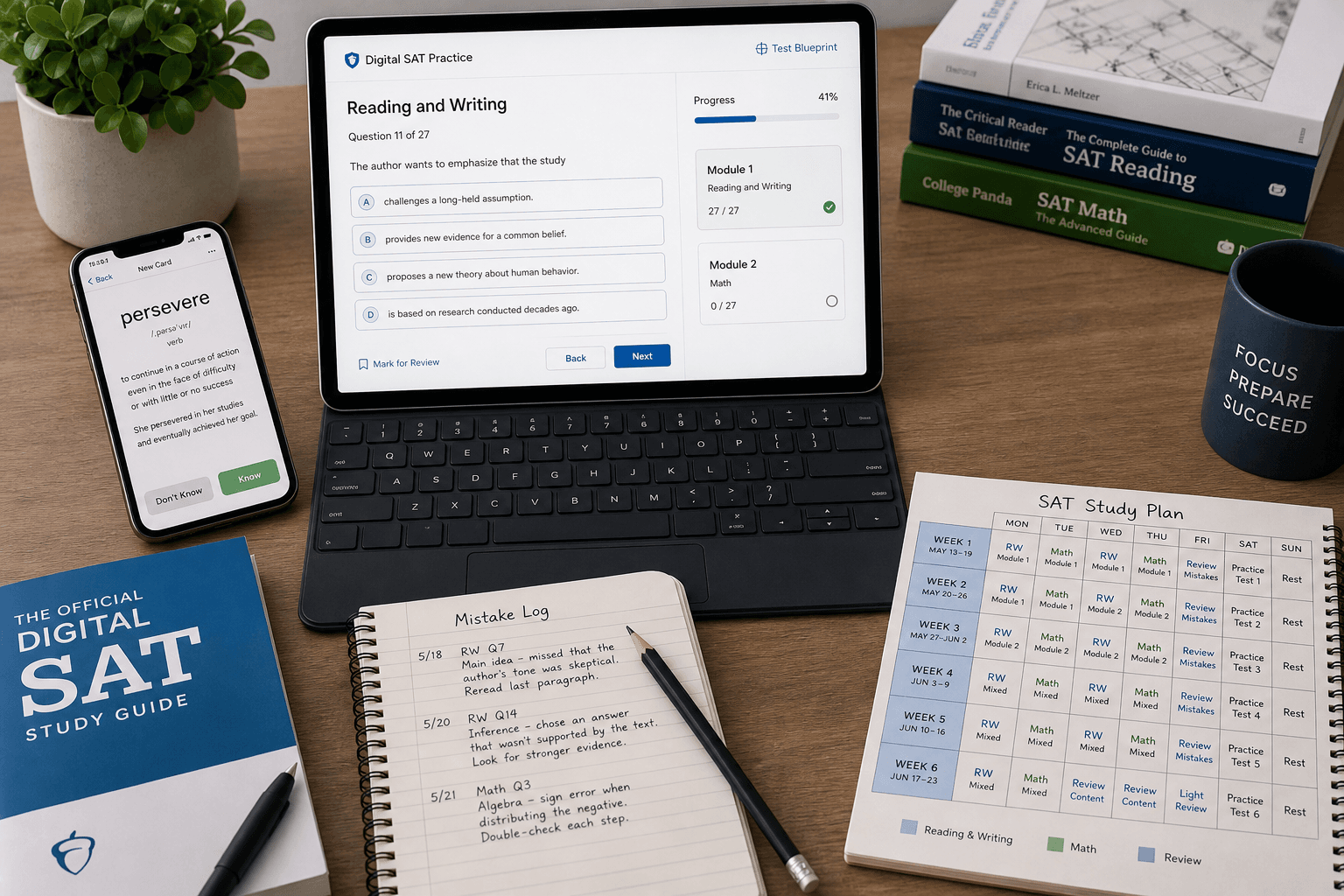
SAT Exam Prep Guide: Best Tools, Study Plans, and Section Strategies for the Digital SAT
A complete prep hub for high school students taking the digital SAT in 2026, covering the right tool stack, timeline-matched study plans, and section-specific strategies — with a free-first approach built around Bluebook, Khan Academy, and spaced repetition flashcard apps.
Updated:
The digital SAT has a specific structure, a specific tool ecosystem, and a specific kind of preparation that works. This guide covers all three — the format you're preparing for, the tools worth your time, study plans matched to your timeline, and section strategies grounded in how the test actually scores you. If you've already worked through the GRE Prep Hub for graduate school planning, this SAT hub follows the same format — but everything here is specific to the high school context and the digital SAT's adaptive design.
Digital SAT Format at a Glance
The 2026 digital SAT has two sections: Reading & Writing and Math. Each section is split into two adaptive modules. You complete Module 1 first, and your performance on it determines whether you receive a harder or easier Module 2.
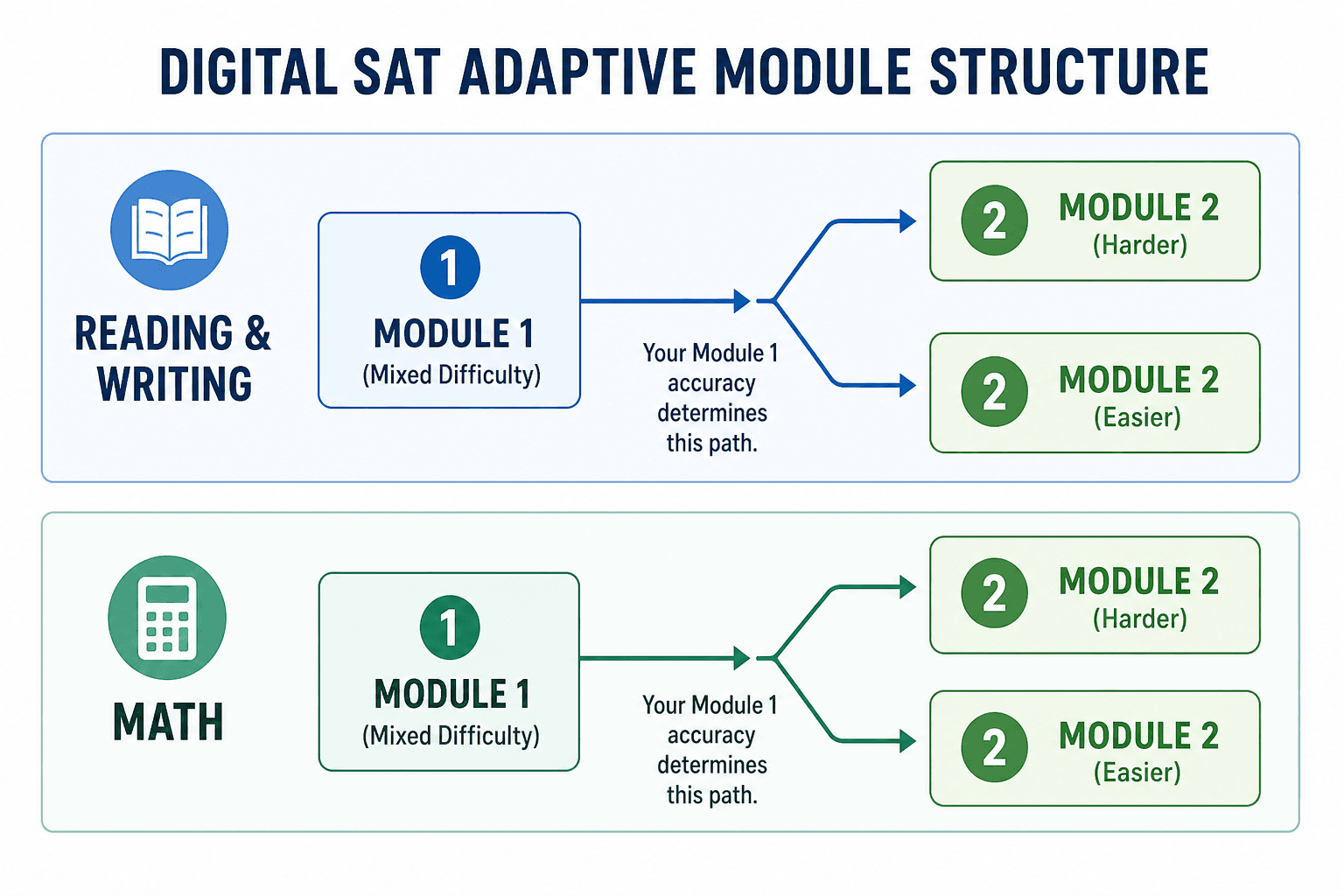
This adaptive design has a direct implication for how you should prepare: early-question accuracy matters more than speed. Students who land in the harder Module 2 have access to the higher score ranges. Students who stumble through Module 1 are routed to an easier module with a lower score ceiling, regardless of how well they perform afterward.
| Section | Modules | Questions per Module | Time per Module |
|---|---|---|---|
| Reading & Writing | 2 adaptive modules | ~27 questions | ~32 minutes |
| Math | 2 adaptive modules | ~22 questions | ~35 minutes |
Setting Your Target Score and Timeline
Before choosing a study plan, you need two numbers: your current score (or estimated baseline) and your target score. The gap between them drives everything — which plan length makes sense, how much supplemental work you need, and whether Khan Academy alone will be enough.
Take a full-length Bluebook practice test before you do anything else. That score is your diagnostic. Do not guess at your baseline — an inflated or deflated estimate will lead you to the wrong plan.
- Score gap under 150 points: A 1–3 month plan is realistic. Khan Academy plus Bluebook tests covers most of what you need.
- Score gap of 150–300 points: Plan for 3 months. You'll need structured content review, not just practice tests.
- Score gap over 300 points: A 6-month timeline gives you room to build foundations without burning out. Rushing a 300+ point gap into 6 weeks rarely works.
Set your target score based on the colleges you're applying to, not on a round number. A 1400 means something different for a student targeting selective schools than for a student targeting regional universities. Look up the 25th–75th percentile SAT ranges for your target schools and aim for the 75th percentile or above if SAT scores are a significant factor in your application.
The Core Tool Stack: Free Official Resources
Three free tools form the foundation of every serious SAT prep plan. These are not optional extras — they are the infrastructure. Everything else in this guide is layered on top of them.
Bluebook
Bluebook is the official College Board app where the real digital SAT is administered. It contains full-length official practice tests — the same adaptive format, the same interface, and the same built-in tools (including Desmos) that you'll use on test day. Practicing in Bluebook means the real test interface causes no surprises.
At the time of writing, College Board has released a set of official Digital SAT practice tests through Bluebook. Verify the current number directly at the College Board practice page before you start, as this count may change. Whatever the current number is, treat each test as a limited resource: ration them across your prep window rather than taking them all in the first month.
Khan Academy
Khan Academy is an official College Board partner and provides free SAT prep aligned to the exact skills tested on the digital SAT. It covers every section with practice questions, video lessons, and hints. For most students scoring below 1350, Khan Academy is the right daily driver — it's strong for concept mastery, grammar rules, and foundational math review.
College Board Question Bank
The College Board Student Question Bank is a searchable database of official SAT questions filterable by skill area and difficulty. It's the best source of targeted drilling on specific question types — use it when you've identified a weak area from your Bluebook test review and want more official practice on that specific skill. The interface is functional but not polished; expect some friction navigating between question sets.
Supplemental Tools Worth Considering
Once your free core stack is in place, supplemental tools can fill specific gaps. None of these are required — but the right one, chosen for your actual weak point, can meaningfully accelerate progress.
Third-Party Practice Platforms
- Mathchops (paid): An adaptive math drilling platform that adjusts question difficulty in real time. Useful for students who have identified specific math content gaps and want volume beyond what the College Board Question Bank provides.
- Score Smart (paid): Provides analytics on practice test performance and realistic question difficulty. Useful for students who want structured reporting on where their score is leaking.
- TestInnovators (paid): Full-length mock tests with structured score reporting. A reasonable Bluebook supplement for students who exhaust the official test supply and need additional full-length simulation.
Spaced Repetition Flashcard Apps for Vocabulary
Vocabulary-in-context questions appear consistently in the Reading & Writing section, and spaced repetition is the most efficient way to build and retain a working SAT-level vocabulary. The method works by surfacing words at increasing intervals as you demonstrate recall — meaning you spend more time on words you don't know and less time on words you've already mastered. Ten to fifteen minutes per day is enough for meaningful vocabulary growth over 8–12 weeks.
- Magoosh SAT Flashcards (free app): SAT-specific vocabulary cards organized by difficulty level with built-in spaced repetition scheduling. The app manages the review cadence automatically — you just show up for 10 minutes a day.
- Anki (free, open-source): More flexible than Magoosh but requires more setup. You can find pre-made SAT vocabulary decks on AnkiWeb or build your own from words you've encountered in practice. Anki's FSRS algorithm makes it one of the most efficient spaced repetition tools available.
- Quizlet (free tier available): Large library of community-made SAT vocabulary sets. Less algorithmically rigorous than Anki but easier to start with. See the Quizlet vs. Knowt comparison if you're deciding between free flashcard apps.
- Brainscape (freemium): Uses a confidence-based repetition system rather than a traditional SRS algorithm. A good option if you prefer rating your own confidence on each card rather than relying on automated scheduling. See the Brainscape app review for a full breakdown.
For a deeper look at how spaced repetition methodology applies to vocabulary retention, the GRE vocabulary flashcards guide covers the underlying principles in detail. The method is the same for SAT-level vocabulary — only the word list differs.
AI-Powered Tools
AI flashcard generators can help you build custom vocabulary decks from SAT word lists or from passages you've encountered in practice. They're most useful for students who want to create personalized card sets rather than use pre-made decks. The AI flashcard generator guide covers how to use these tools effectively and what to watch out for.
Study Plan Templates by Timeline
Three plan lengths cover most student situations. The 3-month plan is the anchor — it's the right window for the majority of students scoring 1100–1400 who are targeting 1300–1500+. The 1-month and 6-month plans are modifications for students with a compressed timeline or a larger score gap.
The 3-Month Plan (12 Weeks): The Optimal Window
Commit to 10–12 hours per week. This is enough to see real score movement without burning out. The plan phases as follows:
| Phase | Weeks | Focus | Primary Tools |
|---|---|---|---|
| Diagnostic & Foundation | 1–2 | Baseline test, identify weak areas, learn the Bluebook interface | Bluebook (1 full test), Khan Academy |
| Content Mastery — Math-Heavy | 3–5 | Front-load Math content review: algebra, quadratics, geometry, data analysis | Khan Academy, Mathchops, College Board Question Bank |
| Section Strategy — R&W Shift | 6–8 | Reading & Writing question types, grammar rules, vocabulary drilling | Khan Academy, Magoosh/Anki flashcards, Question Bank |
| Full Practice Tests | 9–10 | Full-length Bluebook tests every 5–7 days, deep mistake review after each | Bluebook, mistake log |
| Final Polish | 11–12 | Target recurring error types only; no new content; timed simulation | Bluebook (1 final test), mistake log review |
For organizing your content review notes during the content mastery phase, the Cornell Notes template works well — the cue column on the left is useful for flagging grammar rules or math formulas you need to revisit.
The 1-Month Plan: Compressed but Viable
A 1-month plan works if your score gap is under 150 points and you can commit 12–15 hours per week. Compress Weeks 3–10 of the 12-week plan into 3 weeks, prioritizing your two weakest content areas rather than full coverage. Take 2–3 full Bluebook tests. Do not skip the final-week rest — arriving fatigued on test day erases the gains from a compressed prep sprint.
The 6-Month Plan: For Larger Gaps or Earlier Starters
A 6-month plan suits students with a 300+ point gap or students who are starting early (e.g., beginning prep in the fall for a spring test date). Use the first 6 weeks to build foundational skills at a lower intensity (6–8 hours/week), then enter the 12-week plan structure above at Week 7. The extra time allows for a second full review cycle and more practice test volume without compressing the mistake-review process.
Math Section: Key Topics and Strategies
Math is generally the faster section to improve. The content is discrete — once you understand how to solve a quadratic or read a scatterplot, that skill transfers reliably across questions. This makes content-focused review more directly productive in Math than in Reading & Writing, where improvement is more gradual.
High-Priority Content Areas
- Linear equations and systems of equations (consistently the highest-frequency topic)
- Quadratic functions and factoring
- Exponential growth and decay
- Geometry: area, volume, angles, triangles, and circles
- Basic trigonometry: sine, cosine, and right triangle relationships
- Data analysis: interpreting tables, graphs, and statistical measures
Desmos and Calculator Strategy
The Desmos graphing calculator is built into Bluebook and is approved for all Math questions. It is genuinely useful for graphing functions, checking quadratic solutions, and verifying geometric relationships — but only if you've practiced with it before test day. Spend time during your content review phase learning Desmos shortcuts so you're not figuring out the interface under time pressure.
Reading & Writing Section: Question Types and Strategies
Reading & Writing improvement is slower and more cumulative than Math. It responds less to cramming and more to sustained daily exposure — regular reading, consistent grammar drilling, and deliberate practice with specific question types. Expect progress to feel gradual in the first few weeks and then compound.
Question Types to Know
- Inference and main idea: Asks what the passage implies or what the author's central claim is. The correct answer is always directly supported by the text — not by outside knowledge.
- Vocabulary-in-context: Asks for the meaning of a word as used in a specific passage. The answer depends on context, not dictionary definitions — a word like 'sharp' can mean many things depending on the sentence.
- Evidence-based questions: Asks you to identify the sentence or data point that best supports a claim. Practice locating evidence quickly without re-reading the full passage.
- Grammar and usage: Covers subject-verb agreement, pronoun-antecedent agreement, parallel structure, punctuation (especially commas and semicolons), and sentence boundary errors. These are learnable rules — Khan Academy's grammar drills cover them well.
The Core Strategic Principle
Every Reading & Writing question has exactly one correct answer, and every wrong answer is wrong for a specific, identifiable reason. Students who internalize this stop second-guessing between two plausible-sounding options. When you're stuck between two choices, ask: what specific thing makes each wrong answer wrong? One of them will have a clear flaw — an unsupported inference, a word that doesn't fit the context, a grammar rule violation. The correct answer has no such flaw.
Practice Test Cadence and Mistake-Review System
Full-length practice tests are valuable — but only if you review them correctly. Students who take test after test without a structured review process see diminishing returns quickly. The review is where the learning happens, not the test itself.
When to Start and How Many to Take
- Start full-length tests at Week 4 — after your diagnostic and initial content review, not before.
- Take one full test every 5–7 days during Weeks 9–10. More frequent than that doesn't allow adequate review time.
- Target 4–6 full-length tests over a 12-week plan. More than 8 tests produces diminishing returns — the time is better spent on targeted drilling of your specific weak areas.
The Mistake-Review System
For every question you get wrong, categorize the error before moving on. This is the single highest-return habit in SAT prep — it turns a wrong answer from a data point into a learning event.
| Error Type | What It Means | How to Fix It |
|---|---|---|
| Content gap | You didn't know the underlying concept or rule | Review the concept, then find 3–5 similar questions and drill them within the week |
| Careless error | You knew the concept but made a calculation or reading mistake | Identify the specific careless pattern (e.g., misreading 'not' in a question stem) and flag it in your log |
| Strategic error | You used the wrong approach — guessed, ran out of time, or eliminated the right answer | Review your process, not just the answer; identify where the approach broke down |
After categorizing each error, find 3–5 similar questions from the College Board Question Bank and complete them within the same week. Then revisit the original missed question one week later to confirm retention. Track your recurring error types in a weekly log — the top 2–3 patterns across your tests are your highest-priority drilling targets.
If you want to combine your mistake log with spaced repetition flashcards — for example, turning grammar rules or math formulas into reviewable cards — RemNote integrates note-taking and spaced repetition in a single tool, which works well for this kind of error-tracking workflow.
Test-Day Checklist
- Arrive at least 20 minutes early — late arrivals may not be admitted.
- Bring an acceptable photo ID (check College Board's current ID requirements before your test date).
- Charge your device fully the night before; bring a charger if the testing site permits it.
- Confirm you know how to navigate the Bluebook interface: flagging questions, using the Desmos calculator, and pacing yourself within each module.
- Review your pacing targets for each section the night before — not new content.
- Do not study new material in the final two days. Light review of your mistake log categories is acceptable; cramming new grammar rules is not.
- Sleep and eat normally. Fatigue and low blood sugar affect cognitive performance more than an extra hour of studying at 11 PM.
Frequently Asked Questions
Is 3 months enough time to prepare?
For most students with a score gap of 150–300 points, yes — if you commit 10–12 hours per week and follow a structured plan. Three months is long enough for real score movement and short enough to stay focused. Students with smaller gaps can do it in less time; students with larger gaps benefit from 6 months.
How many practice tests should I take?
Four to six full-length tests over a 12-week plan is the right range for most students. More than eight tests produces diminishing returns — the time is better spent on targeted drilling of your specific weak areas. Every test you take should be followed by a full mistake review session. If you're taking tests without reviewing them thoroughly, you're wasting your most valuable practice resource.
Can I realistically improve 300 points?
A 300-point improvement is possible but requires a 6-month timeline, consistent 10–12 hour weekly commitment, and structured work across both sections. It's more achievable in Math (where discrete content review produces faster gains) than in Reading & Writing (where improvement is more gradual). Students who see 300+ point gains typically combine strong content review with a disciplined mistake-review habit over a full prep cycle.
Is Khan Academy enough on its own?
For students targeting scores up to roughly 1350, Khan Academy paired with Bluebook practice tests covers most of what you need. For students targeting 1400+, Khan Academy works well as a concept foundation and grammar drill resource, but you'll likely need the College Board Question Bank for additional official question volume and a supplemental platform for adaptive difficulty. Khan Academy's ceiling is a real limitation for high scorers — it's not a knock on the platform, just an honest assessment of what it was designed to do.
Should I study every day?
Daily consistency beats weekend cramming for SAT prep. Short daily sessions — 45–60 minutes on weekdays, longer sessions on weekends — produce better retention than three-hour marathon sessions twice a week. The one exception: full-length practice tests should be taken in a single sitting to simulate real test conditions, including the timing and mental stamina demands. Flashcard review (10–15 minutes/day) works best as a daily habit separate from your main study block.
Comments
Join the discussion with an anonymous comment.