
GRE Vocabulary Flashcards: How to Choose the Right Tool and Use It Effectively
A practical guide for GRE test-takers who feel overwhelmed by flashcard options — covering how the post-2023 GRE actually tests vocabulary, how to evaluate and choose between Anki, Magoosh, Brainscape, Quizlet, and paper cards, and how to build a daily study routine that turns flashcard drilling into real Verbal score gains.
Deck Sources
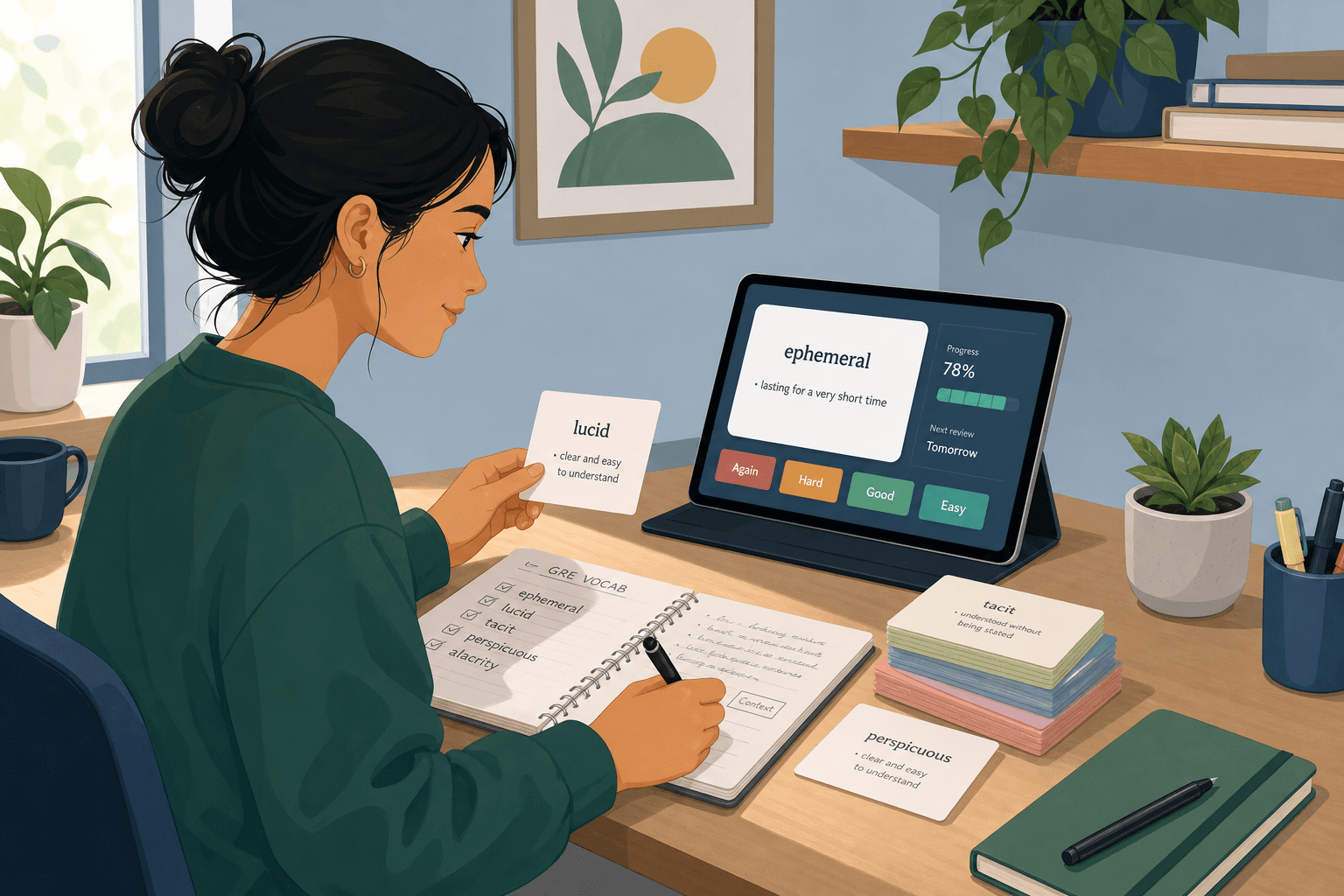
Why GRE Vocabulary Flashcards Matter More on the Shorter GRE
In September 2023, ETS shortened the GRE General Test significantly. The Verbal Reasoning section now contains 27 scored questions, down from 40 in the previous format. That reduction sounds like less pressure — but the math works against you.
With fewer total questions, each one carries more weight. Sentence Equivalence and Text Completion questions — the two types where vocabulary knowledge directly determines whether you get the answer right — now represent a larger share of your final Verbal score. Miss two or three vocabulary-driven questions and you can drop a full scoring band.
This is not an argument that vocabulary is more important than it used to be in an abstract sense. It is a concrete arithmetic point: the cost of a vocabulary miss is higher now than it was before 2023. A deliberate flashcard strategy — one that matches the right tool to your timeline and applies active study methods — matters more, not less, under the current format.
How the GRE Actually Tests Vocabulary
Understanding the question types that reward vocabulary knowledge changes how you should study. The GRE does not ask you to define words in isolation. It tests whether you can recognize the right word — or pair of words — inside a sentence that provides contextual clues.
The two question types where vocabulary pays off most directly are:
- Sentence Equivalence (SE): You are given a single sentence with one blank and asked to select two answer choices that both complete the sentence and produce sentences with equivalent meanings. This question type directly tests synonym recognition in context — you need to know not just what a word means, but which other words carry the same meaning and tone in a given sentence.
- Text Completion (TC): You are given a passage with one to three blanks and must select the word or phrase that best fits each blank based on the logic of the surrounding sentences. TC tests your ability to use sentence structure and context clues to determine which word fits — vocabulary knowledge narrows your options and confirms your reasoning.
The practical implication: rote memorization of dictionary definitions is not enough. A student who has memorized that "loquacious" means "talkative" may still miss an SE question if they do not recognize that "garrulous" and "voluble" are close enough synonyms to pair with it. The GRE rewards contextual synonym knowledge — the kind you build by studying words in groups and in sentences, not in isolation.
Five Flashcard Formats Compared
Not every flashcard format is equally effective for GRE prep — and the right choice depends on your timeline, your comfort with technology, and how much setup time you are willing to invest. The table below compares the five most commonly used formats across the dimensions that matter most for the current GRE.
A note on what the columns mean: SRS algorithm refers to whether the tool automatically schedules reviews based on your performance (more on why this matters in the next section). GRE-specificity reflects whether the word list and card design are built around GRE question types, or whether you are adapting a general-purpose tool. Best-for profile is a learner-type recommendation, not a ranking.
| Format | SRS Algorithm | Word Count | Pricing | GRE-Specificity | Best For |
|---|---|---|---|---|---|
| Anki | SM-2 (built-in, highly configurable) | Varies by community deck | Free (desktop/Android); ~$24.99 one-time (iOS) | Low — depends on deck quality; community decks vary widely | Self-directed learners comfortable with setup and configuration |
| Magoosh GRE Flashcard App | Basic SRS with difficulty tiers (Basic / Common / Advanced) | ~1,000 curated words | Free | High — purpose-built for GRE, words organized by frequency and difficulty | Budget-conscious students who want a trusted free source with GRE-specific curation |
| Brainscape | Confidence-based SRS (user rates recall strength after each card) | 1,600+ cards covering 840+ words across 9 decks | Free to start; ~$8/month for full access | High — ETS-endorsed, includes sample sentences, synonyms, and pronunciation | Learners who want adaptive repetition aligned to ETS standards |
| Quizlet + GregMat lists | Learn mode SRS (adaptive); manual scheduling for GregMat lists | Hundreds of community GRE decks; GregMat covers ~1,110 words in 47 semantic clusters | Free basic; ~$35.99/year Plus | Moderate — deck quality varies; GregMat's semantic groups are excellent for SE prep | Students who want study mode variety and can identify a reliable deck to commit to |
| Paper flashcards | None — manual only | As many as you make | Near zero (index cards) | Only as specific as you make them | Early-stage learners or short offline review sessions; not recommended as a primary method for most timelines |
A few observations worth highlighting before you decide:
- Anki's SRS algorithm is genuinely powerful, but its interface is designed for power users. If you have less than six weeks before your exam, the setup time may not be worth it unless you are already familiar with the tool.
- Magoosh's app is the clearest starting point for most students — it is free, GRE-specific, and requires no configuration. Its limitation is that the SRS is less sophisticated than Anki's or Brainscape's.
- Brainscape's confidence-based system is well-suited to GRE prep because it adapts to the words you are weakest on. Its ETS endorsement is a meaningful signal about content accuracy.
- GregMat's semantic word groups are one of the most valuable free resources for Sentence Equivalence preparation specifically — but they work best as a supplement to a primary SRS tool, not as a standalone system.
- Paper cards are not recommended as a primary method for most GRE timelines. Without automatic scheduling, you will either over-review words you already know or under-review words you are forgetting.
Seven Criteria for Evaluating Any GRE Flashcard Resource
Whether you are choosing between the tools above or evaluating a deck you found on AnkiWeb or a Quizlet set someone recommended, these seven criteria give you a consistent framework for deciding whether a resource is worth your time.
- Reflects the current GRE format and question types. The resource should be calibrated to the post-2023 GRE (27 scored Verbal questions). Any deck or guide that references 40 scored Verbal questions is outdated. Check when it was last updated.
- Contextual definitions and example sentences — not bare definitions. Cards that show the word used in a sentence train the contextual recognition the GRE tests. A card that shows only "pellucid: clear" is less useful than one that shows the word in a sentence with a synonym note.
- Words organized by difficulty or frequency. A resource that groups words by how often they appear on GRE exams — or by difficulty tier — lets you prioritize the words with the highest return on study time.
- Built-in or compatible SRS algorithm. Spaced repetition scheduling is the single most important mechanical feature in a GRE vocabulary tool. If the tool does not include SRS, you need a plan for scheduling your own reviews.
- Synonym grouping support. For Sentence Equivalence preparation, a resource that groups synonyms together — or that you can organize into synonym clusters — is significantly more valuable than one that treats each word in isolation.
- Actively maintained and updated. Community-made decks on Anki and Quizlet vary widely in quality and many have not been updated since before the 2023 format change. Look for a last-updated date or maintenance signal before committing to a deck.
- Fits your timeline and daily workflow. A resource that requires 45 minutes of daily setup is not compatible with a four-week prep timeline. Match the tool's demands to the time you actually have.
Building Your Daily Study Routine by Prep Timeline
How you structure your daily practice matters as much as which tool you use. The most important finding from vocabulary retention research is straightforward: 15–30 minutes of daily practice consistently outperforms multi-hour weekend cramming sessions. Sleep cycles are required to consolidate new vocabulary into long-term memory — there is no shortcut that replaces daily repetition spread across weeks.
A practical target for most students: aim to drill 800–1,200 high-frequency words deeply rather than working through a sprawling 3,500-word list superficially. Knowing 900 words well enough to recognize them in sentence context produces better SE and TC scores than recognizing 2,000 words at a surface level.
| Timeline | Daily Time | Words per Day | Primary Focus | Word-Count Target | Key Techniques |
|---|---|---|---|---|---|
| 1 month | 30–45 min/day | 15–20 high-frequency words | Spaced repetition only — no diversions into roots or reading | Top 500 high-frequency words | SRS scheduling, synonym clusters for SE words, active recall testing |
| 2 months | 30 min/day | 10–15 words/day | SRS as primary; add word roots and light academic reading in the final two weeks | 600–800 words | SRS, synonym cluster drilling, basic mnemonic creation for difficult words, light roots supplement |
| 3+ months | 20–30 min/day | 10–12 words/day | Balanced approach: flashcards, roots, reading, mnemonics, synonym clusters — all reinforcing each other | 800–1,200 words with deep contextual knowledge | Full SRS, synonym clusters, mnemonics, word roots, reading from GRE-level sources (NYT, The Atlantic) |
A note on the one-month timeline: if you have four weeks or fewer, the word count you can realistically cover is limited. Do not try to rush through 1,000 words in 30 days. Instead, focus on the 400–500 highest-frequency GRE words and learn them well enough to recognize them in multiple sentence contexts. Knowing 400 words deeply will serve you better on test day than having a vague familiarity with 1,200.
Memory Techniques That Compound Your Flashcard Gains
Flashcard drilling is the foundation. These four techniques amplify what that drilling produces — they are not replacements for a consistent SRS practice, but they significantly increase how much of what you study actually stays with you.
1. Spaced Repetition Mechanics
The core principle behind spaced repetition is the forgetting curve: without active review, roughly 70% of newly learned material is forgotten within 24 hours. Spaced repetition systems counter this by scheduling each card for review just before you would forget it — not immediately after you learn it, and not weeks later when it has already faded.
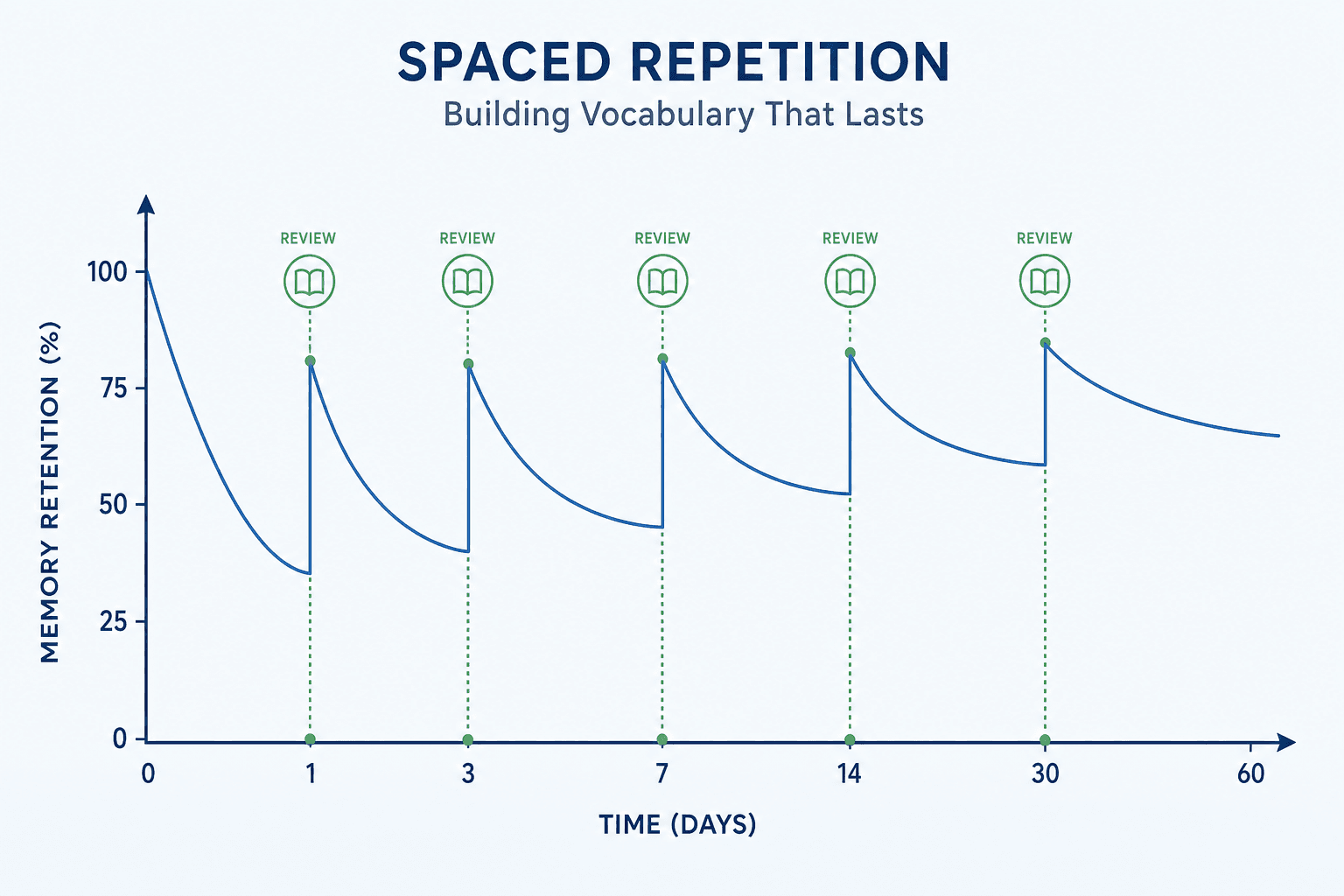
The key insight is that reviewing a word at the moment when recall is effortful — when the answer is almost but not quite on the tip of your tongue — produces a stronger memory trace than reviewing it when it is still fresh and easy. Digital SRS tools like Anki and Brainscape handle this scheduling automatically. If you are using paper cards, the Leitner box system replicates this logic manually:
- Create five card decks (boxes). Review Deck 1 daily.
- Cards you answer correctly move to the next deck; cards you miss from any deck return to Deck 1.
- Review Deck 2 every other day, Deck 3 every three days, and so on — widening the interval as cards advance.
- A card that returns to Deck 1 more than once signals that your current definition is not working. Rewrite it with a personalized sentence, a rhyme, or a visual image.
- Cards that reach Deck 5 are committed to long-term memory.
2. Synonym Cluster Drilling
Sentence Equivalence questions require you to identify two words that produce sentences with equivalent meanings. The most direct way to train this skill is to study words in synonym clusters rather than individually.
Instead of learning "loquacious" as a standalone card, group it with "garrulous," "voluble," and "verbose" under the theme "talkative." Build a single story or sentence that uses all four words. When you encounter any one of them in an SE question, the others will surface naturally — because you learned them as a group, not as four separate facts.
GregMat's semantic word groups are built around this principle — roughly 1,110 high-frequency GRE words organized into 47 meaning-based clusters. Using these lists as a supplement to your primary SRS tool is one of the highest-leverage adjustments you can make to your SE preparation.
3. Mnemonic Creation
Mnemonics work by creating multiple memory links for a single word — phonetic, visual, and semantic hooks that give your brain more retrieval paths. A word with three memory anchors is significantly harder to forget than a word with one.
The phonetic approach is the fastest to create: find a sound in the word that connects to its meaning. For "avaricious" (meaning greedy), the word sounds like "have our riches" — an image of someone clutching a pile of gold. For "aberrant" (meaning deviating from the norm), break it into "a-BEAR-ant" and picture a bear in a business suit at a city intersection — the absurdity encodes the deviation from expected behavior.
You do not need a mnemonic for every word. Reserve them for words that keep returning to Deck 1 in your Leitner system, or that you consistently miss in practice reviews. A few well-constructed mnemonics for your most stubborn words will save more time than trying to build one for every card in your deck.
4. Word Roots as a Supplementary Decoder
Learning 100–200 common Latin and Greek roots gives you a tool for making educated guesses on words you have never seen before. "Bene-" means good (beneficent, benevolent, benign). "Mal-" means bad (malevolent, malign, malefactor). When you encounter an unfamiliar word on test day, root knowledge can narrow the answer choices even when you cannot retrieve the full definition.
The important caveat: English has too many exceptions and borrowed words for roots to be reliable as a primary study method. Use them as a supplement that helps you decode unknowns — not as a replacement for systematic SRS drilling of the high-frequency word list.
Six Flashcard Mistakes GRE Students Make
Most vocabulary study failures are not caused by choosing the wrong tool. They are caused by using the right tool the wrong way. These six mistakes account for the majority of cases where students report that flashcard drilling did not improve their Verbal score.
- Passive re-reading instead of active recall. Flipping through cards and reading both the word and definition does not test your memory — it just exposes you to the information again. Cover the definition, try to recall it, and only then reveal the answer. The effort of retrieval is what builds the memory trace.
- Weekend cramming instead of daily sessions. Cramming 200 words in a single Saturday session gives your brain no time to consolidate what you have learned. Sleep cycles are required for memory consolidation. Five hours in one day produces far less retention than 30 minutes per day over ten days.
- Studying from a sprawling 3,500-word list. The GRE draws heavily from a core of high-frequency vocabulary. A focused 800–1,200 word list drilled deeply will outperform a 3,500-word list studied superficially, both in retention and in test-day performance.
- Learning isolated definitions without synonym context. If your cards only show a word and its definition — no example sentence, no synonyms — you are training dictionary recall, not the contextual synonym recognition that SE and TC actually require.
- Switching tools constantly. Trying a new app every week resets your SRS progress and breaks the scheduling system that makes spaced repetition effective. Pick one primary tool and commit to it for your entire prep period. You can supplement with GregMat's semantic lists, but your SRS deck should be stable.
- Skipping days and breaking the SRS schedule. Spaced repetition scheduling is built around consistent daily reviews. Skip three days and your due cards pile up; skip a week and the algorithm's timing assumptions are no longer accurate. If you must skip a day, do a shorter session rather than skipping entirely — even 10 minutes maintains the rhythm.
Frequently Asked Questions
How many words do I actually need to learn?
For most students, 800–1,200 high-frequency words is the practical target. This is the range where depth of knowledge — recognizing a word in sentence context, knowing its synonyms, being able to distinguish its connotation — produces the highest return on study time. Beyond 1,200 words, the marginal value of each additional word decreases significantly, and the time is often better spent on practice questions.
How long should I study vocabulary each day?
15–30 minutes of focused daily practice is the recommended range for most timelines. This is enough time to review your SRS due cards, add a small number of new words, and reinforce synonym clusters — without the diminishing returns that set in after 45–60 minutes of vocabulary-only study. Consistency matters more than session length.
Is paper or digital better for GRE vocabulary?
Digital tools with built-in SRS are more efficient for most GRE timelines. The automatic scheduling removes the manual overhead of the Leitner box system, and digital cards are easier to include synonym notes and example sentences on. Paper cards have a role in early-stage learning and short offline sessions, but they are not recommended as a primary method for students with four to twelve weeks before their exam.
Can I use multiple flashcard apps at the same time?
Pick one primary SRS tool and commit to it for your entire prep period. Running two SRS apps in parallel doubles your daily review burden without doubling your learning — you end up with two half-maintained decks instead of one well-maintained one.
The exception is GregMat's semantic word groups, which work well as a supplement because they are not an SRS tool — they are a curated list you use to organize your synonym cluster drilling. Use them alongside your primary app (Anki, Magoosh, or Brainscape), not as a second primary app running in parallel.
Related Resources
- MCAT Anki Decks: Best Pre-Made Decks, Where to Get Them, and How to Study →
A complete guide for pre-med students on choosing the right MCAT Anki deck for their timeline and section weaknesses — covering every major pre-made deck with honest pros, cons, and download sources, plus a proven study system built around the suspend-first workflow and AAMC integration.
Comments
Join the discussion with an anonymous comment.