
Active Recall: What It Is, Why It Works, and How to Use It
Active recall — testing yourself to pull information from memory rather than passively reviewing it — is the most evidence-backed study technique available, yet most students avoid it because difficulty feels like inefficiency. This guide explains the science, walks through six practical techniques, and helps you understand why passive study methods like rereading and highlighting create a false sense of mastery.
Best for: all subjects — confirmed across language learning, medical knowledge, history, statistics; flashcards best for vocabulary and discrete facts; blank-page retrieval and Feynman Technique best for conceptual subjects; practice tests best for standardized exam formats
What Is Active Recall?
Active recall is a study method in which you deliberately retrieve information from memory — without looking at your notes. Instead of reading a page and absorbing it passively, you close the book, ask yourself what you just learned, and attempt to produce the answer from scratch.
That distinction matters more than it sounds. Most students spend the majority of their study time in passive mode: rereading highlighted notes, rewatching lecture recordings, or scrolling through slides. These activities feel productive. The material looks familiar. But familiarity is not the same as being able to recall something under exam conditions.
Active recall flips the process. Rather than moving information into your mind through repeated exposure, you practice pulling it out — which is exactly what an exam requires. The act of retrieval itself is what builds durable memory.

The Science Behind Active Recall: Why Retrieval Strengthens Memory
The evidence base for active recall is unusually strong. In a landmark 2013 meta-analysis, Dunlosky and colleagues evaluated ten common study techniques and rated practice testing — the core of active recall — as high utility: the highest possible rating in their framework. Rereading, highlighting, and summarizing all received low utility ratings.
Three mechanisms explain why retrieval practice works so well.
The Testing Effect
Every time you retrieve a memory, you strengthen the neural pathway associated with it. The act of retrieval — not the act of reading — is what makes a memory more accessible in the future. Roediger and Karpicke (2006) demonstrated this directly: students who studied material and then tested themselves on it scored approximately 50% better on delayed retention tests than students who spent the same time re-studying the material.
A follow-up study by Karpicke and Blunt (2011), published in Science, made the case even more starkly. They compared four groups: one that read material once, one that read it four times, one that read and then created a concept map, and one that read once and then practiced retrieval. The retrieval group outperformed all others — including the group that had read the material four times — on both factual and inference-based tests.
Desirable Difficulty
Active recall is harder than rereading. That difficulty is not a bug — it is the mechanism. When retrieval requires genuine effort, the brain interprets the information as important and encodes it more durably. Cognitive scientists call this desirable difficulty: the kind of productive struggle that signals to memory systems that this material is worth retaining.
Think of it like physical training. A workout that feels easy is not building strength. The same principle applies to memory: difficult but successful retrievals produce stronger retention than easy ones.
The Fluency Illusion
This is the mechanism that keeps most students stuck in passive study habits. When you reread your notes, the material starts to look familiar. That familiarity feels like understanding. But recognition is not recall — and exams test recall.
The fluency illusion is why students who spent hours rereading can still blank on an exam. Their brain recognized the information when they saw it but never practiced producing it independently. Active recall directly attacks this illusion by forcing you to generate answers rather than recognize them.
The Forward Effect of Testing
A less widely known benefit: retrieval practice also improves your ability to learn new material studied afterward. A 2014 review by Pastötter and Bäuml documented what they call the forward effect of testing: practicing retrieval on previously studied content enhances encoding of subsequently presented new information. In practical terms, a retrieval session before studying new material primes the brain for better learning — not just better retention of what you already know.
Active Recall vs. Passive Studying: What the Evidence Shows
The appeal of passive study is understandable. Rereading feels comfortable. The material seems to sink in. Progress feels steady. But this comfort is the fluency illusion at work — your brain is recognizing familiar information and mistaking that recognition for genuine mastery.
The Karpicke and Blunt four-group design is worth understanding in detail because it is the clearest evidence of this gap. All four groups studied the same material. The group that read it once and then tested themselves outperformed the group that read it four times. More studying — passive studying — did not compensate for the absence of retrieval practice.
| Study Method | What It Feels Like | What the Evidence Shows |
|---|---|---|
| Rereading notes | Comfortable; material feels familiar | Low utility — creates recognition, not recall (Dunlosky et al., 2013) |
| Highlighting | Active and organized | Low utility — does not require processing meaning |
| Rewatching lectures | Easy; feels like learning | Passive exposure; recognition without retrieval |
| Active recall / retrieval practice | Effortful; uncomfortable | High utility — significantly better delayed retention (Roediger & Karpicke, 2006) |
| Practice testing | Challenging; exposes gaps | High utility — outperforms rereading even 4× (Karpicke & Blunt, 2011) |
Six Active Recall Techniques (And How to Use Each One)
Active recall is not a single method — it is a principle that can be applied in several ways. The right technique depends on your subject, your materials, and how much time you have. Here are six practical approaches, with instructions and the most common mistake to avoid for each.
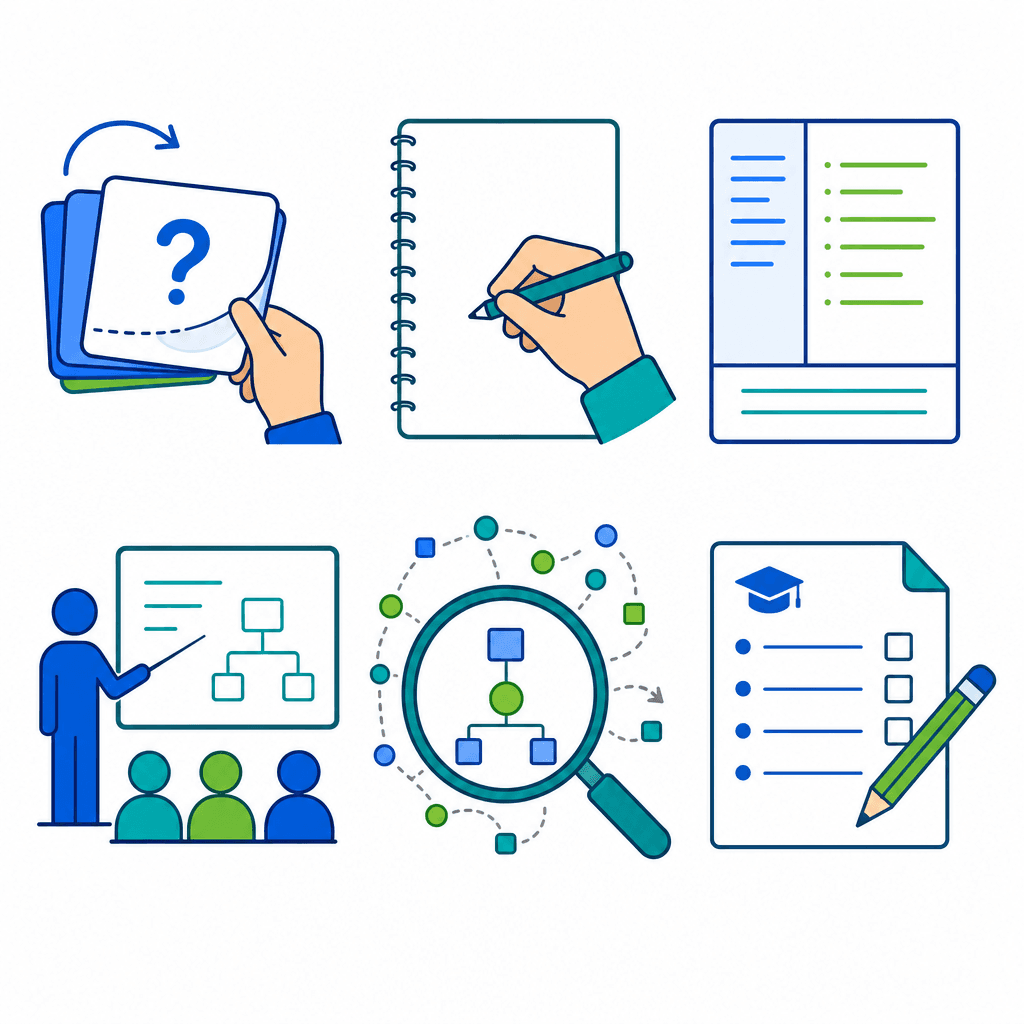
1. Spaced-Repetition Flashcards
Flashcards are the most direct implementation of active recall. You see a prompt, attempt to retrieve the answer from memory, then check whether you were right. When combined with spaced repetition — reviewing cards at increasing intervals based on how well you recalled them — flashcards become the most efficient memory system available for discrete facts, definitions, and vocabulary.
How to use it: Write one question per card with the answer on the back. Cover the answer, attempt retrieval, then flip. Rate your confidence honestly. Avoid multiple-choice formats on your own cards — forced recall is harder than recognition, and that difficulty is the point.
2. Practice Tests and Past Papers
Sitting a practice test under realistic conditions is one of the highest-impact retrieval activities available. It forces retrieval across a broad range of material, exposes gaps you did not know existed, and mirrors the conditions of the actual exam.
How to use it: After studying a topic or chapter, close your notes and attempt the relevant practice questions. Review your answers critically. Treat wrong answers as diagnostic information, not failure — they tell you exactly what to review next.
3. Blank-Page Retrieval (Blurting)
This method is low-tech and works especially well for conceptual, interconnected subjects like biology, history, or economics. Close your notes, take a blank sheet of paper, and write down everything you can remember about a topic — in any order, in any format.
How to use it: Set a timer for five to ten minutes. Write freely without checking your notes. When the timer ends, open your notes and compare. The gaps between what you wrote and what you missed are your next study targets.
4. The Feynman Technique
Named after physicist Richard Feynman, this technique requires you to explain a concept as if you were teaching it to someone with no background in the subject. The constraint of simple language exposes gaps in understanding that standard recall does not surface — you can retrieve a definition without understanding the concept well enough to explain it.
How to use it: Pick a concept. Close your notes. Write or say an explanation in plain language — no jargon allowed. When you get stuck or your explanation becomes vague, that is the gap. Return to your source material, fill the gap, then try the explanation again.
5. Cornell Question Notes
Cornell-style notes divide a page into a narrow left column for questions and a wider right column for notes. After taking notes in the right column, you convert key ideas into retrieval questions in the left column. The right column is then covered, and you use the questions to test yourself.
How to use it: During or immediately after a lecture, write your notes in the right column. Within 24 hours, generate a question for each major idea and write it in the left column. In future review sessions, cover the right column and answer each question from memory before uncovering the notes to check.
6. Teach-Back (The Protégé Effect)
Explaining material to another person — a classmate, a study partner, or even an imaginary audience — forces you to organize and articulate your knowledge in a way that self-testing alone does not always require. Research on the protégé effect shows that preparing to teach material drives deeper encoding than studying for your own recall.
How to use it: Assign each person in a study group a topic to teach. Prepare without looking at notes during the explanation itself. After the explanation, the group asks clarifying questions — these questions surface the gaps. This works best when each person is assigned a different topic rather than everyone teaching the same content.
Active Recall and Spaced Repetition: Two Mechanisms, One System
Active recall and spaced repetition are often discussed together — and for good reason. They are complementary mechanisms that address different parts of the memory problem.
Active recall is the retrieval act: you test yourself on material to strengthen the memory trace. Spaced repetition is the scheduling mechanism: it determines when to retrieve — spacing reviews at increasing intervals to catch memories just before they fade. Together, they maximize long-term retention far more effectively than either approach alone.
Tools That Support Active Recall
Several apps are built specifically to operationalize active recall, removing the friction of manually scheduling reviews or creating retrieval prompts from scratch.
- Anki — The most widely used spaced-repetition flashcard app. You create your own cards, and Anki schedules reviews based on how well you recalled each one. Free on most platforms. Requires some setup effort. Best for students who want precise control over their retrieval practice. See the Anki Flashcard App Review for feature and pricing details.
- Quizlet — Offers a large library of pre-made academic flashcard sets. Its Learn and Test modes apply retrieval practice directly: Learn presents cards and requires you to produce answers; Test generates a quiz from your set. More accessible for beginners than Anki.
- RemNote — Combines note-taking with integrated flashcard generation. If you prefer to keep your notes and your retrieval practice in the same system, RemNote converts highlighted notes into flashcards automatically.
- Brainscape — Uses confidence-based repetition scheduling and offers expert-created content for certifications and professional exams. Useful for students who want curated decks rather than building their own.
If you are deciding between Anki and Quizlet, the Anki vs. Quizlet comparison covers the key trade-offs by use case, including which is better suited for medical students, language learners, and casual learners.
Common Active Recall Mistakes and How to Avoid Them
Most active recall errors share a common pattern: the student takes a shortcut that converts a retrieval task back into a recognition task. Here are the most frequent mistakes and why they undermine the technique.
- Peeking before retrieving. The most common mistake across all active recall methods. Glancing at the answer before genuinely attempting retrieval eliminates the retrieval attempt entirely. The discomfort of not knowing the answer is the signal to push harder, not to look.
- Passive card reading. Reading a flashcard with the question and answer visible simultaneously is not active recall — it is passive review with extra steps. Always cover the answer before attempting retrieval.
- Using practice tests before studying the material. Practice tests function as retrieval practice on content you have already learned. Using them as a first exposure — before any studying — does not produce the same retention benefit. Study the material first, then test.
- One more reread before testing. The urge to reread 'just once more' before attempting recall is the fluency illusion in action. The material feels slightly unclear, so rereading feels justified. But retrieval practice — even imperfect retrieval — builds stronger memory than another passive pass.
- Treating summary note-making as active recall. Writing a summary of your notes while looking at them is a passive activity. It involves selection and organization, but not retrieval. Summaries become active recall only when you write them from memory, with notes closed.
Frequently Asked Questions
How much of my study time should be active recall?
A practical rule of thumb: allocate at least 20–30% of each study session to active retrieval. For most students, this is a significant shift — passive review tends to consume the majority of study time by default. If you are new to active recall, start by replacing one passive review pass with a blank-page retrieval attempt or a set of flashcard reviews, and build from there.
Can active recall be combined with other study methods?
Yes — and certain combinations are particularly effective. Active recall pairs well with interleaving (mixing different topics or problem types within a single session rather than blocking by subject), which strengthens the ability to discriminate between concepts. It also works well with elaborative interrogation (asking 'why' and 'how' questions rather than just 'what'), which deepens conceptual understanding beyond factual recall.
Does active recall work for all subjects?
Yes. The research base for retrieval practice spans a wide range of domains — language learning, medical knowledge, history, and statistics, among others. The specific technique you use may vary by subject: flashcards suit vocabulary and discrete facts; blank-page retrieval and the Feynman Technique suit conceptual subjects with interconnected ideas; practice tests suit subjects with standardized exam formats. The underlying mechanism — retrieving from memory rather than recognizing from a page — applies across all of them.
Apply This Method
Related Methods
- Spaced Repetition: How It Works and Why the Science Backs It
A research-grounded explainer for high school and college students on how spaced repetition turns your brain's forgetting mechanism into a long-term retention tool — covering the cognitive science, optimal scheduling principles, and both app-based and manual implementation paths.
Comments
Join the discussion with an anonymous comment.