
Spaced Repetition: How It Works and Why the Science Backs It
A research-grounded explainer for high school and college students on how spaced repetition turns your brain's forgetting mechanism into a long-term retention tool — covering the cognitive science, optimal scheduling principles, and both app-based and manual implementation paths.
Best for: language learning, vocabulary, factual knowledge, science, medical and exam-heavy courses; also applicable to skill-based domains with caveats
Why Studying Hard Isn't the Same as Studying Smart
Most students who cram for an exam feel like it's working. The material starts to feel familiar. Names and dates come back quickly when you flip through the same notes a third time. That sense of fluency is real — but it's not the same as learning.
Psychologists call this the fluency illusion: repeated exposure to material creates a feeling of mastery that doesn't survive the distance between the exam room and the real world. Recognition — the kind triggered by re-reading — is processed differently in the brain than recall. You can recognize a face you'll never be able to name. The same gap exists between "this looks familiar" and "I can actually retrieve this when I need it."
The problem isn't effort. Students who cram are genuinely working hard. The problem is that effort and encoding are not the same thing. Massed practice — reviewing the same material repeatedly in a single session — produces strong short-term performance and rapid long-term decay. You've experienced this: you aced the test, then remembered almost nothing three weeks later.
Spaced repetition is the method that closes this gap. It's not a productivity hack or a study-tips trend. It's one of the most replicated findings in cognitive psychology, and understanding why it works will change how you approach every subject you need to actually remember.
What Spaced Repetition Actually Is
Spaced repetition is a study method in which you review material at increasing time intervals, timed to catch information just before it fades from memory. Instead of reviewing everything in one long session, you spread reviews across days and weeks, with the gaps between sessions growing longer as the memory becomes more stable.
The concept has a specific origin. In 1885, German psychologist Hermann Ebbinghaus conducted the first systematic experiments on human memory using himself as the subject. He memorized lists of nonsense syllables, then tracked how quickly he forgot them. His data produced the forgetting curve — a mathematical description of memory decay over time — and his observation that reviewing material at spaced intervals dramatically reduced the effort needed to relearn it.
The method remained largely theoretical until 1973, when German science journalist Sebastian Leitner formalized it into a practical system using physical flashcard boxes. Leitner's system — cards moving forward on correct answers and returning to the beginning on incorrect ones — gave students a low-tech way to implement the spacing principle without any calculation. That system is still in use today, and the principle behind it now powers sophisticated software algorithms.
The Forgetting Curve: Your Brain's Default Setting
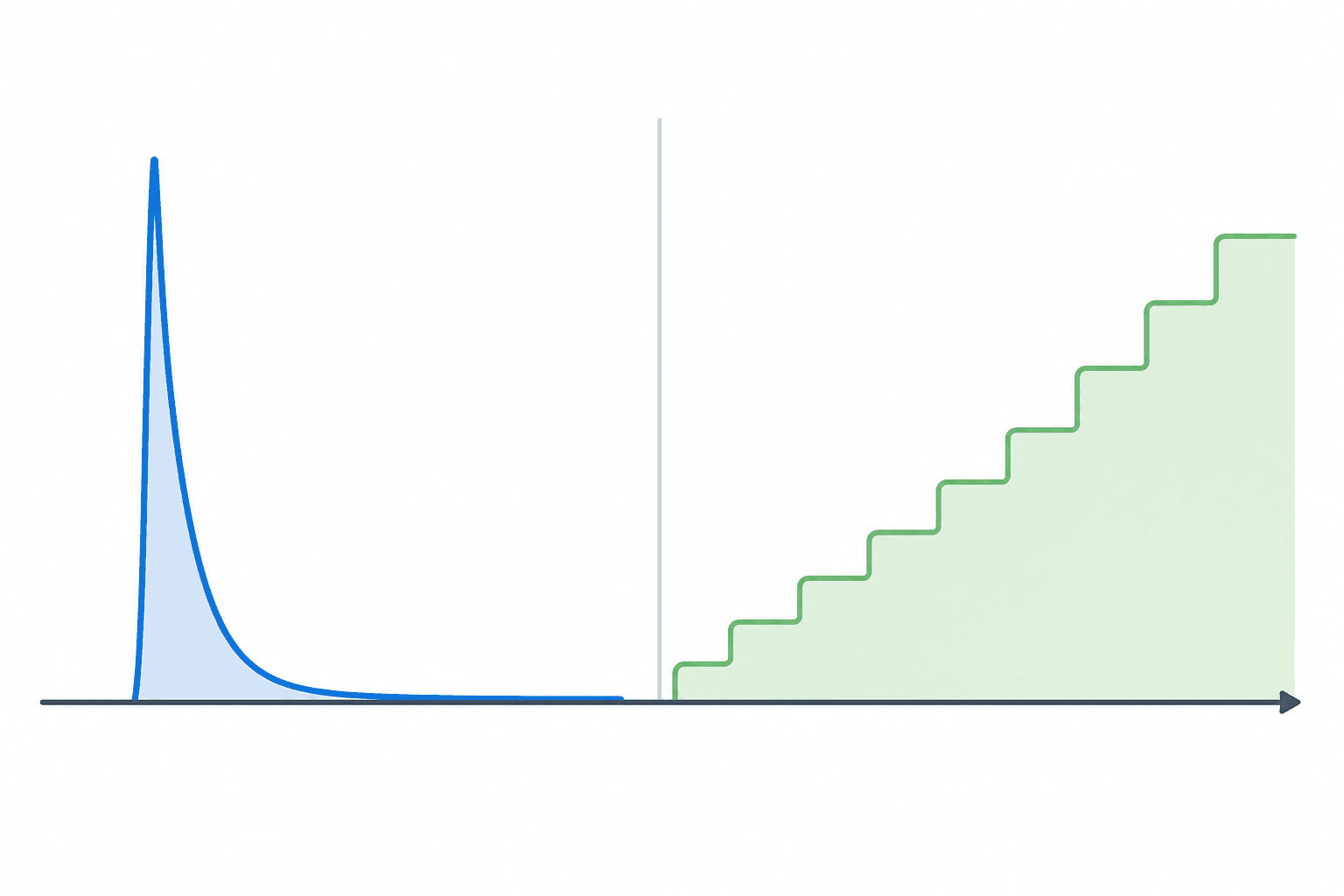
Ebbinghaus's most important finding wasn't that we forget — it's how fast we forget. His data showed that without any review, roughly 50% of new information is lost within the first hour of learning it. Within a week, that figure climbs to approximately 90%. A 2015 replication study confirmed this decay pattern holds across modern learners.
This isn't a flaw in your memory. It's a feature of how the brain manages cognitive resources. Your brain treats infrequently accessed information as low-priority signal. If you encounter something once and never return to it, the brain's implicit conclusion is that this information isn't worth the metabolic cost of long-term storage. The memory weakens and eventually becomes inaccessible.
The forgetting curve isn't a straight line — it's steep at first and flattens over time. Most of the decay happens in the first 24 hours. This is why the timing of the first review is so critical: waiting a week to review material you learned on Monday is almost equivalent to starting over.
Why Forgetting Is the Point, Not the Problem
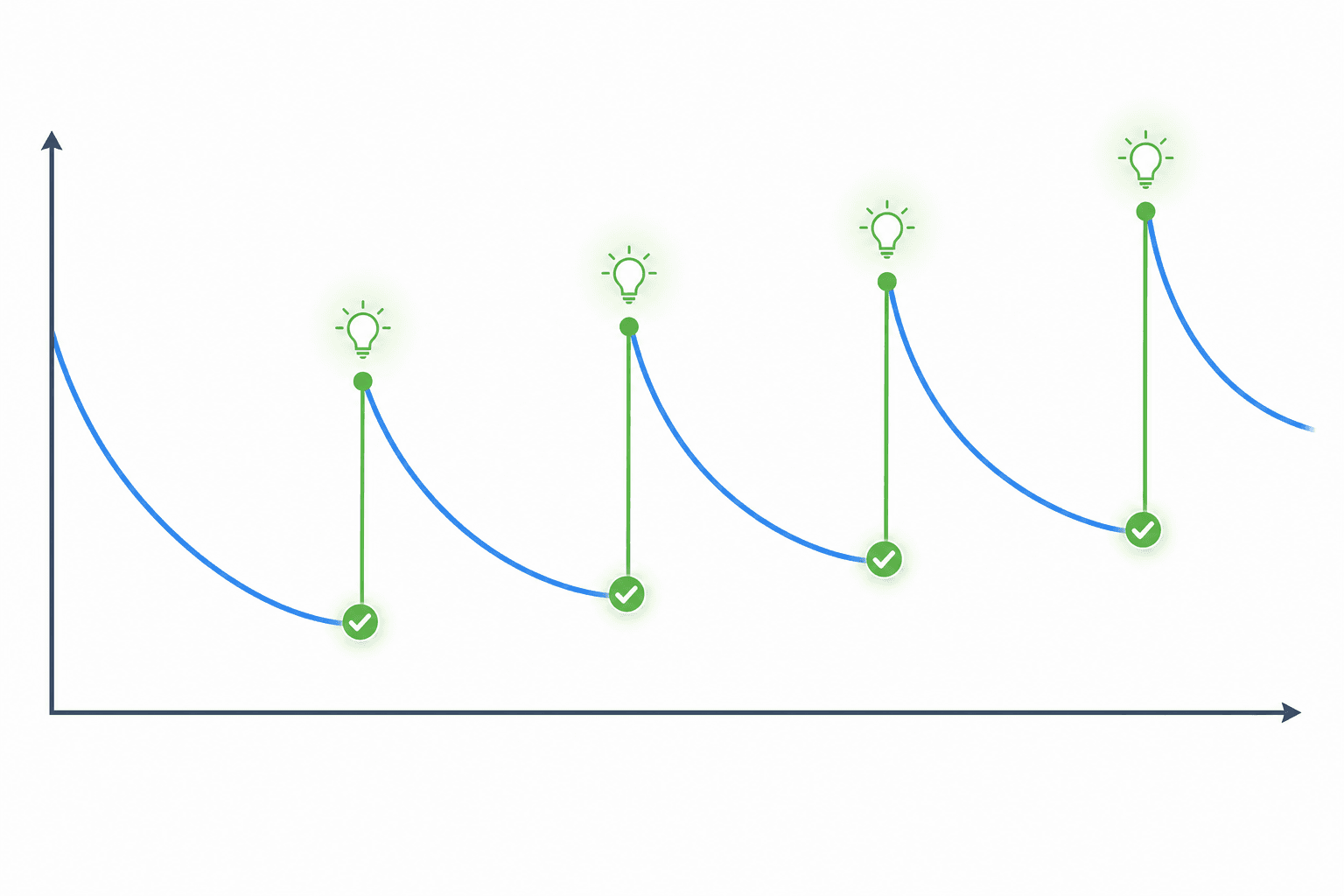
Here's the counterintuitive insight that separates spaced repetition from other study strategies: the partial forgetting between reviews isn't a sign the method is failing. It's the mechanism that makes it work.
Cognitive psychologist Robert Bjork introduced the concept of "desirable difficulties" to describe this phenomenon. When you return to material after a gap — when some forgetting has occurred — your brain has to work harder to retrieve it. That retrieval effort isn't wasted struggle. It's a signal to the brain that this information matters enough to invest in more durable storage.
The science behind this is called reconsolidation. Every time you retrieve a memory, you don't just read it — you reactivate it, and in doing so, you destabilize it briefly before it restabilizes in a stronger form. Smith and Scarf (2017) proposed a reconsolidation account of the spacing effect: greater time between repetitions allows for more complete consolidation, which in turn makes the subsequent reconsolidation triggered by retrieval more effective at strengthening the memory.
This is fundamentally different from what happens during cramming. When you review the same material repeatedly in a single session, you're not triggering reconsolidation — you're triggering recognition. The memory feels strong because it's fresh, not because it's been structurally reinforced. Remove the familiarity cue a week later, and the memory is largely gone.
How the Brain Builds Durable Memory
The difference between spaced repetition and cramming isn't just behavioral — it's neurological. Spaced learning engages different biological mechanisms than massed practice, and those mechanisms produce structurally different kinds of memories.
- CREB transcription factor activation. Spaced learning activates CREB (cyclic AMP response element-binding protein), a transcription factor that switches on genes involved in strengthening synaptic connections between neurons. Crucially, CREB requires time between learning sessions to complete its molecular processes. Cramming doesn't give CREB that time. Each spaced session builds on the synaptic work of the previous one; massed sessions don't allow this accumulation.
- Long-term potentiation (LTP). Progressive repetition of material separated by irregular spacing intervals leads to long-term potentiation — a lasting enhancement of synaptic signaling. Research reviewed by Yuan (2022) shows that massed instruction, which deprives the brain of the refractory period between repetitions, increases mental fatigue and triggers rapid decay of temporary memory. EEG studies show spaced learners produce stronger LPC signals — a neural marker of long-term memory representation — compared to massed learners.
- The hippocampal-to-cortical shift. New memories initially depend heavily on the hippocampus. Over time, with repeated retrieval, they transfer to more distributed cortical storage — a form that is more stable and less vulnerable to disruption. Spaced repetition accelerates this transfer. Smith and Scarf (2017) cite research showing that spaced rats whose memories had been repeatedly reactivated retained fear responses to a context even after hippocampal lesioning, while massed-practice rats were amnesiac after the same lesion.
- Different neural pathways for different repetition types. Research by Lee (2008) demonstrated that massed and spaced repetitions engage different molecular mechanisms entirely. When two training trials occurred on the same day, blocking BDNF (a protein involved in synaptic plasticity) disrupted memory. When trials were separated across two days, blocking ZIF268 — a transcription factor involved in reconsolidation — disrupted memory instead. Spaced and massed practice aren't just quantitatively different; they're qualitatively different at the neurological level.
The practical implication: memories built through spaced repetition are not just stronger — they're more resistant to interference and more accessible under pressure. That's the kind of memory you need in an exam, not the kind you build the night before.
Optimal Intervals: The 10–20% Rule and Example Schedules
Knowing that spaced repetition works is one thing. Knowing when to schedule your reviews is another. Researcher Nicholas Cepeda and colleagues identified what's become known as the 10–20% rule: the optimal review gap is roughly 10–20% of the total time you want to retain the information.
This relationship follows an inverted-U curve. Review too soon — before meaningful forgetting has occurred — and you're getting recognition practice, not retrieval practice. Review too late — after the memory has fully decayed — and you're essentially relearning from scratch. The productive zone is the gap where the memory is accessible but requires genuine effort to retrieve.
| Retention Goal | Optimal Review Gap (10–20% Rule) | Example Schedule |
|---|---|---|
| 1 week | 1–2 days | Study Monday → Review Tuesday or Wednesday |
| 1 month | 3–5 days | Study Week 1 → Review Days 4–5 and Days 10–12 |
| 3 months | 1–2 weeks | Study → Review at 1 week, 3 weeks, 6 weeks |
| 1 year | 1–2 months | Study → Review at 6 weeks, 3 months, 6 months |
For students who want a concrete starting schedule, the University of Arizona Thrive Center recommends a 1-3-7-14 day pattern: review the day after initial learning, then two to three days later, then one week from the original study session, then one week after that. This pattern aligns well with the 10–20% rule for material you want to retain over a semester.
Treat these schedules as heuristics, not algorithms. The principle — reviewing in the productive zone just before forgetting — matters more than hitting an exact day. A review that's slightly off-schedule is far more valuable than a review that never happens.
Active Recall: The Engine That Powers Spaced Repetition
Spacing your reviews is necessary but not sufficient. What you do during those reviews determines whether you get the full benefit of the method. Spaced repetition requires active recall — generating an answer from memory rather than recognizing it from a prompt.
The distinction matters enormously. Passive rereading exposes you to the correct answer without requiring retrieval. Your brain processes the information, but it doesn't have to work to produce it. Active recall — covering your notes and trying to produce the answer, using a flashcard with the answer hidden, answering practice questions without looking — forces the retrieval process that makes memories durable.
Roediger and Karpicke's research on the testing effect demonstrated that generating an answer strengthens the memory trace far more than re-exposure to the same material. This is sometimes called retrieval practice: the act of retrieval itself is a learning event, not just a measurement of learning.
- Generating answers (active recall): Covering the answer and producing it from memory. Strengthens the retrieval pathway and triggers reconsolidation.
- Recognizing answers (passive review): Reading material with the answer visible. Produces familiarity but not durable retrieval pathways. This is what most students do when they "study" by re-reading notes.
When you use flashcards, practice tests, or self-quizzing during your spaced reviews, you're combining both high-utility strategies simultaneously. That combination is why the method outperforms nearly every other approach in long-term retention research.
How to Implement Spaced Repetition: Apps and Manual Systems
There are two implementation paths: app-based and manual. Both deliver the spacing principle effectively. The choice comes down to your subject matter, your comfort with technology, and how much you want the scheduling handled for you.
App-Based Implementation
Apps like Anki use scheduling algorithms (SM-2 and the newer FSRS algorithm) to calculate review intervals automatically based on your performance on each card. Answer a card correctly and the interval extends; answer incorrectly and it resets. The algorithm does the interval math for you, which removes the main friction of manual scheduling.
Quizlet includes a built-in spaced mode that applies similar spacing logic to sets you've created or imported. The interface is more accessible for students who find Anki's setup steep, though the algorithm is less customizable.
The advantage of apps is consistency: the scheduling happens whether or not you remember to plan it. The main risk is passive card creation — importing large pre-made decks without understanding the material, then grinding through reviews without genuine active recall.
Manual Implementation
The Leitner box system uses five physical boxes and a stack of flashcards. Cards start in Box 1. Answer correctly and the card advances to the next box, which you review less frequently. Answer incorrectly and the card returns to Box 1. A common review frequency pattern: Box 1 daily, Box 2 every other day, Box 3 weekly, Box 4 every two weeks, Box 5 monthly.
A calendar-based index card system is a simpler alternative. Write the date of each planned review on the back of the card when you study it, using the 1-3-7-14 schedule as your default. Each day, pull the cards scheduled for that day, test yourself, and reschedule based on your accuracy.
| Approach | Best For | Scheduling Effort | Cost |
|---|---|---|---|
| Anki (FSRS/SM-2) | Large card volumes, MCAT/language learning, students comfortable with setup | Low — algorithm handles intervals | Free (desktop); one-time fee for iOS |
| Quizlet spaced mode | Students who want a familiar interface, collaborative deck sharing | Low — built-in scheduling | Free tier available; paid for full features |
| Leitner box (physical) | Students who prefer tactile study, small-to-medium card sets | Medium — manual box management | Cost of index cards only |
| Calendar + index cards | Students who want full control, any subject | Medium — manual date tracking | Cost of index cards only |
A 5-Step System to Start Today
- Choose one subject or topic you're currently studying and create 10–20 flashcards covering the core concepts. Keep each card to a single fact, definition, or concept — not a paragraph.
- Schedule your first review for the next day. Don't wait longer than 24 hours after initial learning.
- During each review, cover the answer and generate it from memory before checking. Rate your recall honestly — correct only if you produced the answer without prompting.
- For cards you recalled correctly, extend the next review interval (follow the 1-3-7-14 pattern or let your app calculate it). For cards you missed, return them to the short-interval queue.
- Add new cards gradually — 5 to 10 per day maximum when starting. Flooding your deck with new material creates a review backlog that undermines the system.
Common Mistakes That Undermine the Method
- Reviewing too soon. Reviewing material the same day you learned it, or multiple times in a single session, is massed practice in disguise. If retrieval feels effortless, the interval is too short.
- Mistaking familiarity for learning. If you can recognize the answer when you see it but can't produce it without a prompt, you haven't learned it yet. The fluency illusion is strongest after a recent review — it fades fast.
- Quitting during the difficult early phase. Spaced repetition feels harder than cramming in the short term because you're doing genuine retrieval work. Students who quit at this point conclude the method doesn't work. It does — the discomfort is the mechanism.
- Skipping difficult cards. Cards that keep returning to the short-interval queue are the ones that need the most work. Skipping or burying them defeats the purpose of the system.
- Waiting too long between sessions. Intervals that exceed the retention window mean you're relearning, not reviewing. If you're consistently getting below 70% accuracy, your gaps are too long — shorten them until your accuracy stabilizes around 85%.
- Creating cards passively. Importing large pre-made decks without understanding the material means you're reviewing content you never properly encoded. Spaced repetition reinforces learning; it doesn't replace initial understanding.
Frequently Asked Questions
- How much time does it take each day? For maintenance of an established deck, 10–15 minutes per day is realistic. The daily session is short because you're only reviewing cards that are due — not the entire deck. The time investment is front-loaded when you're building the deck and establishing the habit.
- Does it work for complex concepts, not just vocabulary? Yes, with adjustments. Vocabulary and factual recall are the most natural fit. For complex concepts, break them into smaller, testable components — one card per mechanism, one card per cause-and-effect relationship. Avoid cards that require you to recall a paragraph; they're hard to review reliably.
- How do I know if my intervals are calibrated correctly? The 85% accuracy signal is your calibration tool. If you're consistently above 90%, your intervals are too short. Below 75%, they're too long. Aim for the productive struggle zone where retrieval requires genuine effort but succeeds most of the time.
- Digital or paper — does it matter? The research supports the principle, not the medium. Both physical flashcard systems and digital apps produce the spacing effect. Choose the format you'll actually use consistently. Some students find physical cards more engaging for initial card creation; others prefer the automated scheduling of apps for large volumes.
- When will I actually see results? Early improvements in recall appear within the first few weeks. The full long-term payoff — the kind measured in studies comparing retention at 150 weeks — develops over two to three months of consistent practice. Research reported by byheart.io found students who used spaced learning retained 82% of course material at 150 weeks, compared to 27% for students who crammed.
- Does it work for skills, not just factual knowledge? Yes, but the benefit profile differs. For language and factual knowledge tasks, spaced repetition primarily improves long-term retention — massed and spaced groups often perform similarly on immediate tests. For skill-based tasks, the research reviewed by Smith and Scarf (2017) shows spacing can improve both learning and retention. Studies in surgical training, typing, golf, and piano all show spacing benefits. The mechanism and magnitude vary by domain, but the principle applies broadly.
Comments
Join the discussion with an anonymous comment.