
Quizlet Flashcard App Review: Features, Pricing, and Who It's Best For (2026)
A current, factual profile of Quizlet covering its study modes, spaced repetition approach, AI features, and free vs. paid pricing — so high school and college students can decide whether Quizlet fits their needs and whether Plus is worth paying for.
Updated:
What Is Quizlet?
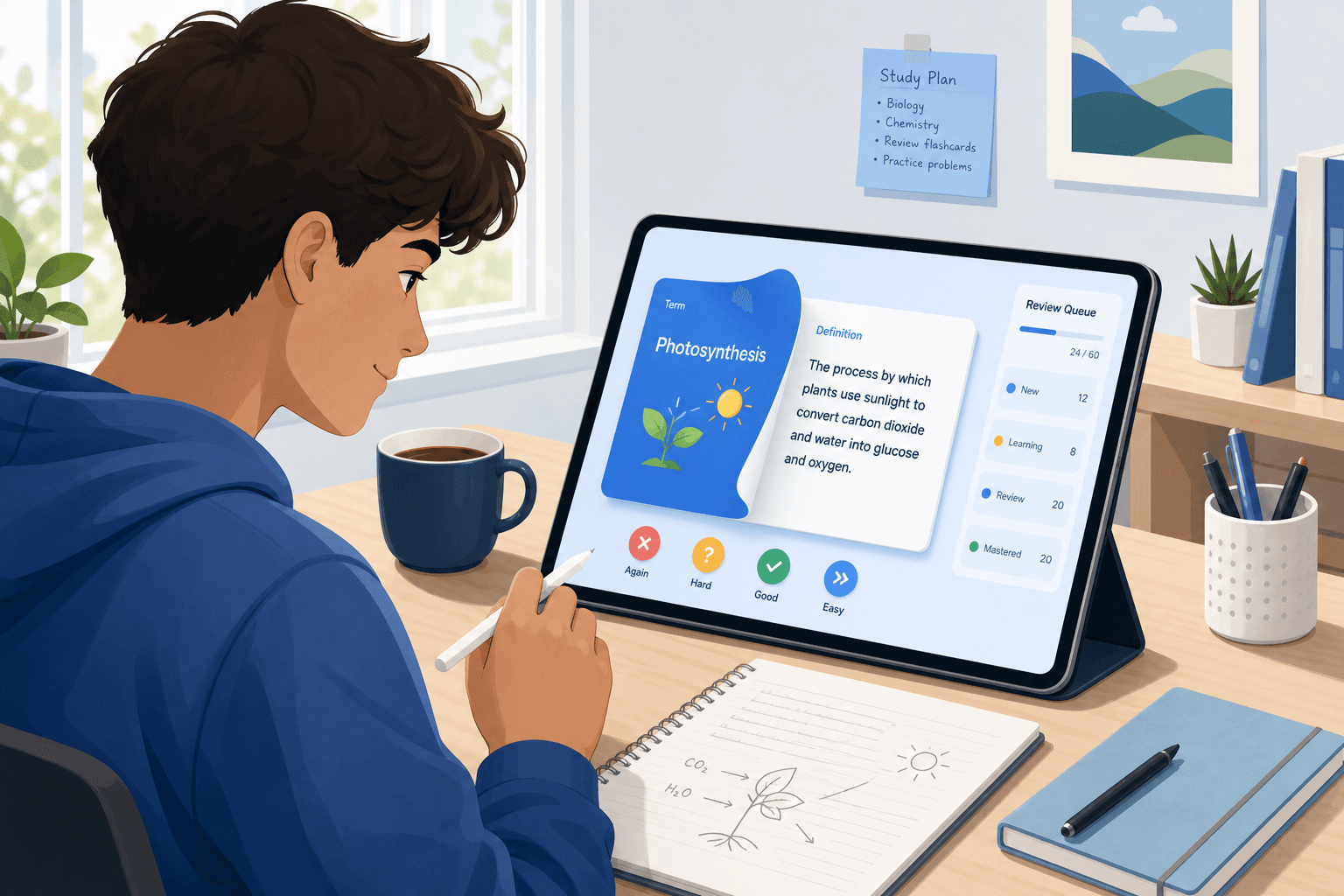
Quizlet is a freemium flashcard platform founded in 2005. It has grown to over 300 million learners worldwide, making it the most widely used digital flashcard tool in existence. The core product is simple: create a set of term-and-definition cards, then study them through a handful of built-in modes.
Quizlet is built for beginners and casual learners first. The interface is clean, the onboarding is fast, and millions of pre-made study sets are available to use immediately without building your own. That accessibility is its biggest strength — and also the reason it falls short for students who need serious spaced repetition control or offline-first study.
It is not a deep memory-science tool. If you are looking for algorithmic precision comparable to Anki, Quizlet is not that product. But for high school vocabulary, language learning, and term-recall prep for standardized tests, it covers the fundamentals well.
Supported Platforms
- iOS (iPhone and iPad)
- Android
- Web browser (all major browsers on Windows, macOS, Linux, and Chromebook)
There is no dedicated desktop app for Windows or macOS. All desktop access is through the browser. The mobile apps are well-maintained and closely mirror the web experience.
Study Modes: What You Can Do in Quizlet
Quizlet offers six study modes. Not all of them are fully available on the free tier, and the paywall line has shifted since 2025.
- Flashcards — The basic flip-card mode. You see a term, flip to see the definition. Free and unlimited. Simple but effective for initial exposure to new material.
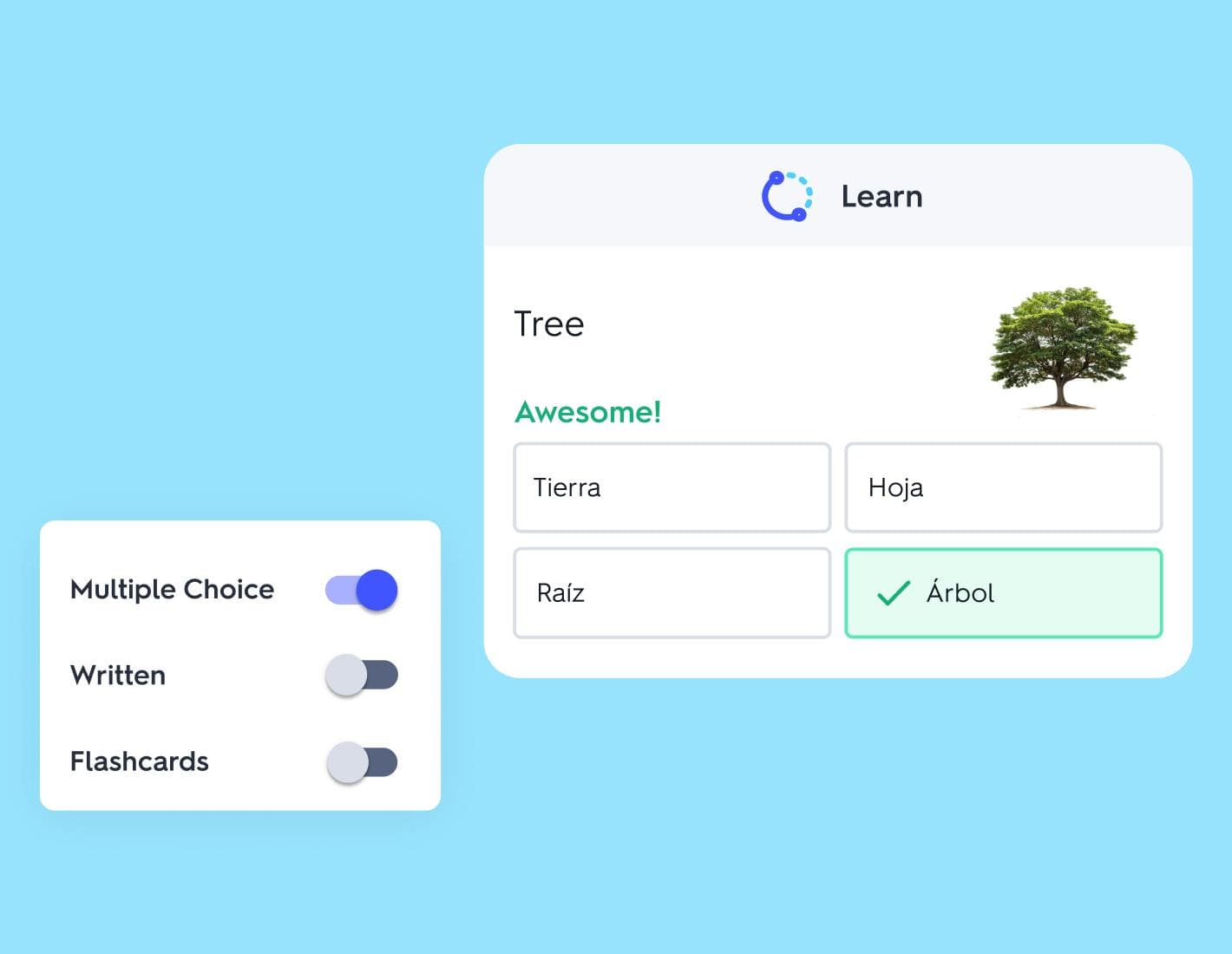
- Learn — The adaptive study mode. Quizlet presents terms in multiple formats (written answer, multiple choice) and adjusts which cards appear based on your performance. Free tier access is capped — daily usage limits apply since the 2025 paywall expansion. Unlimited Learn rounds require Plus.
- Test — Generates a practice test from your set using written, matching, true/false, and multiple-choice questions. Free tier access is limited; full Test mode is part of Plus.
- Match — A timed drag-and-drop matching game. Free and available without limits. Good for quick engagement but does not build long-term retention on its own.
- Write — Prompts you to type the definition or term from memory. Useful for spelling-sensitive content like foreign language vocabulary. Availability on free tier has been progressively restricted.
- Quizlet Live — A classroom multiplayer mode where students compete in teams to match terms and definitions. Designed for teachers running live sessions, not self-study. Requires a teacher account to host.
Spaced Repetition in Quizlet: How Learn Mode Works
Quizlet's Learn mode uses a proprietary adaptive scheduling algorithm. It is not SM-2, not FSRS, and not any other named open algorithm. Quizlet has not published the technical details of how it schedules card repetitions.
In practice, the algorithm works like this: cards you answer correctly appear less frequently; cards you miss or answer slowly appear again sooner. The system tracks your performance across a session and routes harder terms back into the queue. This is a form of adaptive repetition, but it is not the same as the mathematically grounded interval scheduling in Anki.
For most high school and casual college use cases, this is sufficient. For students who need precise control over review intervals — pre-med students building long-term retention for MCAT content, for example — the lack of a documented, configurable algorithm is a real limitation.
AI Features: What's Available After Q-Chat Was Shut Down
The AI feature that remains active is Magic Notes. This is Quizlet's primary AI tool as of mid-2026.
- Magic Notes — Flashcard generation: Upload a PDF, paste text, or import notes, and Magic Notes generates a study set of flashcards automatically. The output quality depends on the quality and structure of your source material.
- Magic Notes — Summaries: Generates a condensed summary of uploaded content. Useful for getting an overview before drilling into flashcards.
- Magic Notes — Practice tests: Creates a practice test from uploaded material. Similar to the Test mode but generated from your own notes rather than a manually built set.
Magic Notes is a Plus feature. Free accounts do not have access to AI-generated flashcard creation from uploaded content.
Quizlet Pricing: Free vs. Plus vs. Plus Unlimited
| Tier | Price (Web) | Key Inclusions | Key Limits |
|---|---|---|---|
| Free | $0 | Flashcards mode, Match game, limited Learn and Test rounds, access to public study sets | Daily caps on Learn and Test; no offline access; no AI features; ads present |
| Plus | $35.99/year or $7.99/month | Unlimited Learn and Test, offline access, Magic Notes AI features, no ads, custom images in cards | Some usage caps still apply; Magic Notes has generation limits |
| Plus Unlimited | $44.99/year | Everything in Plus, with higher or removed usage caps on Magic Notes and study modes | Annual billing only at this tier |
Key Limitations to Know Before You Subscribe
- Paywall expansion since 2025. Features that were previously free — including full access to Learn and Test modes — now have daily caps on free accounts. The free tier is meaningfully less useful than it was before 2025. Students who relied on Quizlet as a completely free tool will find the experience more restricted.
- User-generated content accuracy risk. The majority of Quizlet's study sets are created by other students, not subject matter experts. Errors, outdated information, and imprecise definitions are common. Always cross-check study set content against your course materials or a reliable textbook before an exam.
- Limited SRS control. Quizlet's adaptive algorithm is a black box. You cannot configure review intervals, adjust ease factors, or export scheduling data. For students who want granular control over their spaced repetition practice, this is a hard ceiling.
- Not suited for STEM problem-solving. Quizlet is built around term-definition pairs. It does not support worked examples, multi-step problem practice, or the kind of reasoning-intensive review that math, physics, or organic chemistry typically requires. Using Quizlet as your primary study tool for STEM courses is a poor fit.
- No offline access on free plan. Already noted above, but worth repeating as a standalone limitation for anyone who studies in low-connectivity environments.
- Mixed user sentiment. Quizlet holds a 1.4/5 on Trustpilot and a 4.3/5 on Google Play from over 765,000 ratings. The gap is not a contradiction — it reflects two different user groups. Trustpilot reviews skew toward users who hit paywall friction or had billing issues. Google Play ratings reflect the broader population of active mobile users, many of whom use the free tier for casual study. Both numbers are real; neither tells the complete story on its own.
Who Quizlet Is Best For — and Who Should Look Elsewhere
| Student Type | Quizlet Fit | Reason |
|---|---|---|
| High school students — vocab and definitions | Strong fit | Fast setup, huge library of pre-made sets, accessible interface with no learning curve |
| Language learners — vocabulary building | Good fit | Term-definition format maps well to vocabulary acquisition; large community sets for major languages |
| SAT / GRE / MCAT — term recall and vocabulary | Good fit for recall | Effective for high-volume vocabulary drilling; not a replacement for full MCAT content review |
| Casual learners — trivia, general knowledge | Strong fit | Low commitment, easy to browse public sets, Match game is genuinely engaging |
| Students who need offline access (free plan) | Poor fit | Offline requires Plus; free plan is online-only |
| Pre-med / MCAT — long-term retention | Weak fit | Proprietary algorithm lacks the interval precision of Anki for multi-month retention building |
| STEM problem-solving (math, physics, chemistry) | Poor fit | Term-definition format does not support worked examples or multi-step reasoning |
| Students who need strict SRS control | Poor fit | No configurable intervals, no algorithm transparency, no data export |
The honest summary: Quizlet works best when the study task is high-volume, definition-based, and low-stakes enough that algorithm precision does not matter. It works worst when the student needs deep retention over months, problem-solving practice, or offline access without paying.
Notable Alternatives
- Anki — Free and open-source. Uses the FSRS algorithm for mathematically grounded spaced repetition. Steeper learning curve than Quizlet, but significantly more powerful for long-term retention. The right choice for pre-med students and anyone who needs serious SRS control. See the full Anki profile for details.
- Knowt — Free AI flashcard generation from notes and PDFs, without a paywall. A strong alternative for students who want Quizlet's Magic Notes feature without paying for Plus.
- Brainscape — Uses a confidence-based repetition system where you rate how well you knew each card. A middle ground between Quizlet's simplicity and Anki's complexity, with a cleaner interface than Anki for beginners.
Verdict
Quizlet remains the most accessible flashcard platform for students who are new to digital study tools or who need a fast, low-friction way to drill vocabulary and definitions. Its library of pre-made sets, clean mobile apps, and beginner-friendly interface are genuine strengths that no other tool matches at the same scale.
But the 2025–2026 paywall expansion changes the free-vs-paid calculus. The free tier is now a limited preview of the product, not a functional study tool for daily use. If you plan to use Learn mode regularly — which is the mode that actually builds retention — you will hit the cap. At that point, the choice is to pay for Plus or switch to a tool that is genuinely free.
Q-Chat is gone. Magic Notes is the AI story now, and it is a Plus-only feature. If AI flashcard generation from your own notes is the reason you are considering Quizlet, Knowt offers a comparable feature at no cost.
Comments
Join the discussion with an anonymous comment.