
MCAT Study Prep Guide: Best Tools, Timelines, and a Phase-by-Phase Plan
A comprehensive hub for pre-med students planning MCAT preparation — covers how the exam is structured, how to set a realistic study timeline based on your content baseline, and which free and paid tools to use at each phase of prep from content review through full-length simulation.
Updated:
MCAT at a Glance: What the Exam Actually Tests
The MCAT is a single-day, 7.5-hour exam divided into four sections. Each section is scored on a 118–132 scale, giving a total range of 472–528. The national average sits around 501. Competitive medical schools typically want scores in the 510–520+ range, though exact cutoffs vary by program.
| Section | Questions | What It Tests |
|---|---|---|
| Chemical and Physical Foundations of Biological Systems | 59 questions | General chemistry, physics, organic chemistry, and biochemistry — applied to biological contexts |
| Critical Analysis and Reasoning Skills (CARS) | 53 questions | Reading comprehension and analytical reasoning across humanities and social science passages — no science background required |
| Biological and Biochemical Foundations of Living Systems | 59 questions | Biology, biochemistry, and organic chemistry — the heaviest content section for most students |
| Psychological, Social, and Biological Foundations of Behavior | 59 questions | Psychology, sociology, and biology applied to behavior and mental health — high-yield memorization content |
CARS is the section that surprises most pre-med students. It tests critical thinking, not science knowledge. No amount of biology review improves a CARS score — only consistent, deliberate reading practice does. This is why CARS preparation must start on day one of your prep, not after content review is complete.
How to Set Your Study Timeline (It Starts With Your Baseline, Not the Calendar)
The most common timeline mistake is picking a test date based on the calendar — "I have six months, so I'll take it in March" — without first diagnosing how much content you actually need to cover. AAMC's own guidance is explicit: your prep should be based on your schedule, your current content understanding, and what you still need to learn and practice applying.
Before you commit to any timeline, take the free AAMC unscored Sample Test. It mirrors the real exam in format and difficulty, gives you a content breakdown by topic, and lets you assign confidence levels across the full content outline. That diagnostic is your actual starting point — not the date you hope to test.
| Timeline | Total Hours | Best For | Weekly Commitment |
|---|---|---|---|
| 3 months | 300–400 hours | Students with recent relevant coursework and a strong content baseline | ~25 hours/week |
| 6 months | 400–500 hours | Most students balancing coursework, jobs, or other commitments | ~17–20 hours/week |
| 12 months | 500+ hours | Non-traditional students, career changers, or students with significant content gaps | ~10–12 hours/week |
Regardless of your timeline, structure your prep in two phases: a content-heavy first half (roughly 70% content review, 30% practice) and a practice-heavy second half (70% practice, 30% content reinforcement). CARS practice — at least one to two passages daily — belongs in both halves from the start.
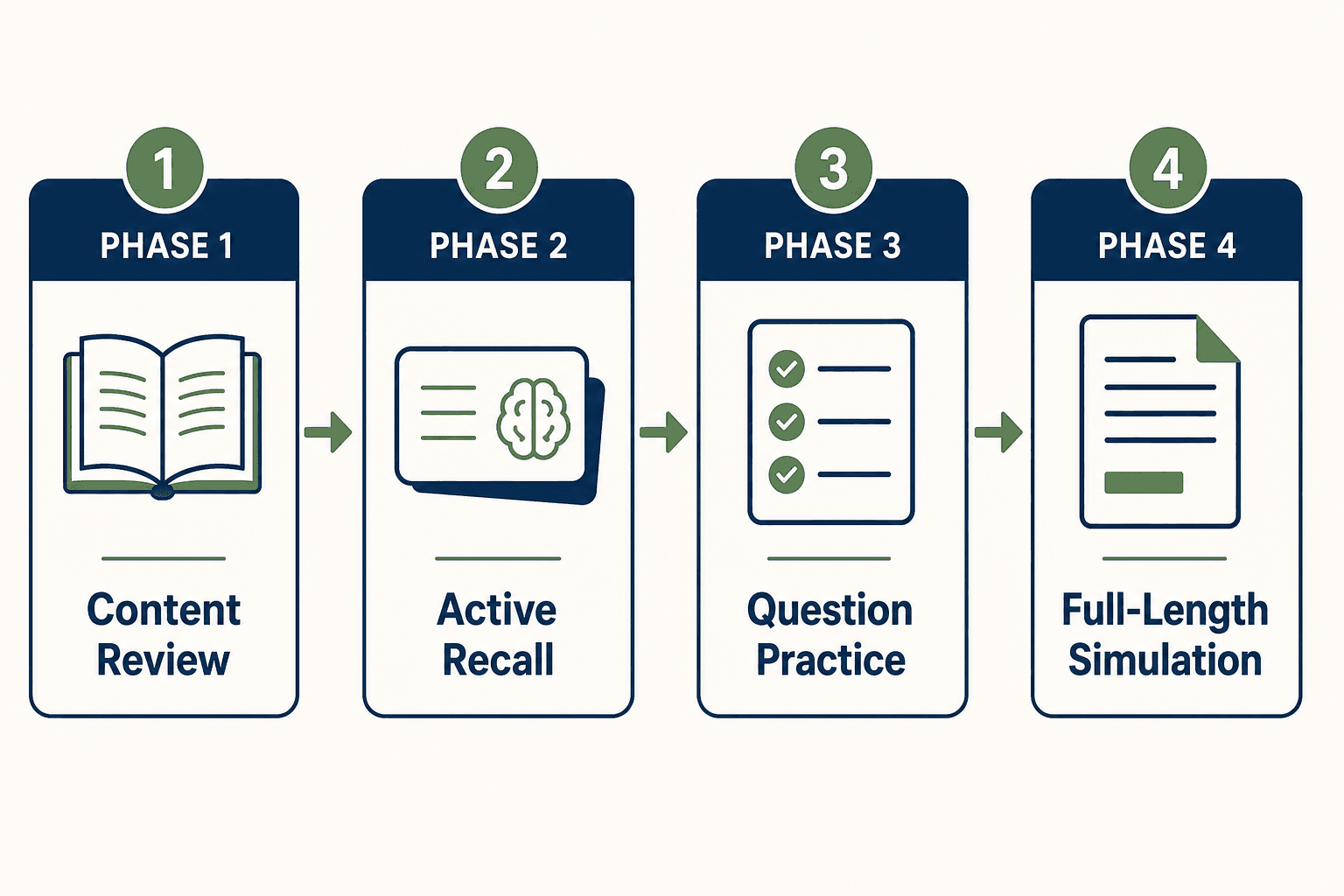
Phase 1 — Content Review: Building Your Foundation
Content review is where you close the gaps identified in your baseline diagnostic. The goal is not to memorize every fact — it is to build a working understanding of the concepts the MCAT applies in novel contexts. A commonly cited guideline is a 1:2 ratio of content review to practice: for every hour of content study, you should spend two hours on practice questions and active recall. In a 3-month plan, that means roughly one month of content followed by two months of practice. In a 6-month plan, approximately two months of content followed by four months of practice.
Review Books
Structured review books remain the backbone of content prep for most students. Three sets dominate the market:
- Kaplan 7-Book Set — Dense, thorough, and text-heavy. Best for students who want comprehensive coverage and are comfortable with a high reading load. Widely available and frequently updated.
- Blueprint 6-Book Set — More visually organized than Kaplan, with integrated digital tools and adaptive analytics. Better suited to tech-forward learners who want their print and digital prep connected.
- Princeton Review 7-Book Set — A solid alternative that works well in hybrid classroom or self-study setups. Comparable in depth to Kaplan with slightly different organizational choices.
Khan Academy — Free Video Reinforcement
Khan Academy's MCAT collection — developed in partnership with AAMC and the Robert Wood Johnson Foundation — includes over 1,100 videos and 3,000 review questions covering all four sections. It is completely free and is one of the most credible free resources available because of its direct AAMC connection.
Khan Academy works best as a supplement to review books, not a replacement. Use it to clarify concepts you find confusing in print, to reinforce biochemistry and physics topics visually, and to fill gaps without purchasing additional books.
Sketchy — Visual and Mnemonic Learning
Sketchy uses animated, story-based lessons to encode high-yield memorization content into visual narratives. It is particularly effective for biochemistry, psychology/sociology, and biology topics where the volume of discrete facts is high and traditional reading tends to produce shallow retention.
Sketchy is a paid subscription. It is not essential for every student — students who retain well through reading may not need it. But for visual learners struggling to make biochemistry or psych/soc content stick, it delivers a meaningful advantage over repeated re-reading.
Phase 2 — Active Recall and Retention: Anki Decks and Flashcard Tools
Active recall — retrieving information from memory rather than re-reading it — is one of the most evidence-supported study techniques available. Anki implements this through spaced repetition: it schedules each card for review at the optimal interval before you would forget it, compressing the time needed to build durable long-term memory.
For MCAT prep, the most important thing about Anki is starting early and maintaining daily consistency. Starting a large deck two months before your test date will produce a backlog that becomes unmanageable. Starting five or six months out and doing 30–50 new cards per day produces a sustainable, compounding retention advantage.
The Three Major Free Community Decks
Three community-built Anki decks dominate MCAT prep forums. They are all free, but they differ significantly in size, style, and workload:
| Deck | Card Count | Style | Best For | Start Timing |
|---|---|---|---|---|
| Jacksparrow2048 | 5,978 cards | Mixed recall and critical thinking; covers all three science sections plus AAMC flashcards | Students who want maximum coverage and can handle a heavy daily workload | 5+ months out; no more than 50 new cards/day |
| MileDown | 2,900 cards | Cloze-deletion with embedded Khan Academy video links; topic-sorted | Most students — efficient, organized, and manageable | 3–5 months out |
| Ortho528 | 4,351 cards | Cloze-deletion with images; faster to move through but lighter on explanations | Students who want image reinforcement and faster card throughput | 3–5 months out |
Paid Flashcard Alternatives
If you prefer pre-built, expert-verified flashcards over community decks, two paid options are worth knowing:
- Blueprint Flashcards — 1,600+ adaptive digital flashcards integrated with Blueprint's analytics platform. Best for students already using Blueprint's broader prep ecosystem.
- UWorld Flashcard Tool — 4,000+ cards with built-in spaced repetition, included with UWorld's QBank and course subscriptions. Convenient if you are already using UWorld for question practice.
Neither paid option is meaningfully superior to a well-maintained free community deck for most students. The advantage of paid flashcards is editorial quality control and integration with a broader platform — not card count or algorithm sophistication.
Phase 3 — Question Practice and CARS: Where Scores Are Actually Built
Question practice is where MCAT prep actually produces score gains. Reading content is passive; working through questions forces you to apply knowledge in the format the exam uses, exposes gaps you did not know existed, and builds the reasoning habits the MCAT rewards. Do not wait until content review is complete to start question banks — begin integrating practice questions from the first weeks of your prep.
AAMC Official Materials — Non-Negotiable
AAMC materials are written by the same team that writes the real exam. No third-party question bank perfectly replicates AAMC's reasoning style, passage structure, or answer choices. Every prep plan — regardless of budget — must include AAMC's official question products.
- AAMC QPacks (CARS QPacks I and II) — Paid. The most authentic CARS practice available. Use these in the practice phase, not during content review.
- AAMC Section Banks — Paid. High-difficulty, section-specific question sets. Particularly valuable for identifying persistent content weaknesses in the final preparation phase.
- AAMC Content Outline Course — Free. Includes 120 retired practice questions organized by content area. Useful for baseline diagnostic and early content-phase practice.
UWorld QBank — Best Third-Party Question Bank
UWorld's MCAT QBank contains 3,000+ questions with detailed visual rationales. Students and instructors consistently identify it as the third-party bank that most closely mirrors AAMC's question style and difficulty — a distinction that matters because the closer a practice resource is to the real exam, the more directly it prepares you for test day.
UWorld questions tend to run slightly harder than the real MCAT, which many students find beneficial: if you can perform well on UWorld, AAMC-difficulty questions feel more approachable. The standalone QBank is a paid product; verify current pricing at purchase.
Jack Westin — Free Daily CARS Practice
Jack Westin publishes a free daily CARS passage that closely mirrors MCAT CARS difficulty, complete with detailed explanations. This is the strongest free CARS resource available and should be part of every student's daily routine from the start of prep through test day — regardless of whether you also purchase AAMC's CARS QPacks.
Phase 4 — Full-Length Simulation: Timing, Review Strategy, and the Missed Question Log
Full-length practice exams serve a specific purpose: they simulate test-day stamina, timing pressure, and the cognitive demands of a 7.5-hour exam. They are not a tool for learning new content. Taking full-lengths before your content gaps are addressed produces misleading scores and wastes your most valuable practice materials.
Target the final 6–8 weeks of your prep for full-length exams, aiming for 7–8 total with at least 5 being AAMC official exams. Space them approximately one per week to allow full review between each.
Available Full-Length Practice Exams
- AAMC Free Unscored Sample Test — Free. 230 questions in the same format as the real exam. Best used at the start of prep as a baseline diagnostic, not saved for the practice phase.
- AAMC Free Scored Practice Exam 1 — Free. 230 questions with a scaled score and percentile rank. The most valuable free full-length available — save it for the practice phase.
- Additional AAMC Official Practice Exams — Paid. AAMC offers additional full-length exams through its Official Prep Hub. Exact current availability and pricing should be verified directly with AAMC before purchase.
- UWorld Full-Length Exams — Paid (included with UWorld course subscriptions). Two custom full-length exams. Useful to supplement AAMC full-lengths, not replace them.
How to Review Full-Length Exams: The Missed Question Log
Taking a full-length exam is not where scores improve. Reviewing it is. Spend the day after each full-length in a structured review session, not another practice session. A Missed Question Log (MQL) is the most effective review tool: for every question you missed or guessed on, record three things — the topic, the cause of your error (content gap, reasoning error, or misread), and the specific fix you will apply next time.
Review your MQL before each subsequent practice session. The MQL is your personal content-gap tracker — it tells you exactly where to focus your remaining prep time instead of reviewing material you already know.
The Free-Only MCAT Prep Path: What's Realistic Without Spending on Courses
A free-only prep path is viable for disciplined, self-directed students. It requires more organizational effort than a paid course and has real limitations — but it is not a second-tier option for students who execute it well.
Here is what a complete free-only path looks like:
- Khan Academy MCAT Collection — 1,100+ videos and 3,000 review questions covering all four sections. Free. Use as your primary content review resource.
- Anki with MileDown Community Deck — Free. Anki desktop app is free; the MileDown deck is free on AnkiWeb. (Note: Anki's mobile app carries a one-time purchase fee on iOS.) Start early and maintain daily reviews.
- Jack Westin Daily CARS Passages — Free. One passage daily from the start of prep. Non-negotiable for CARS improvement.
- AAMC Free Unscored Sample Test — Free. Use at the start of prep as your baseline diagnostic.
- AAMC Free Scored Practice Exam 1 — Free. Save for the practice phase as a scored full-length.
- MilesDown Free PDF Review Sheets — Free. High-yield subject summaries with explanations and mnemonics. Useful for final-week review.
- Kaplan Quicksheets (Free PDF) — Free. A concise formula and concept reference for the final days before your exam.
Quick-Reference Tool Comparison by Prep Phase
| Tool / Resource | Phase | Cost Tier | Free Tier Available | Best For |
|---|---|---|---|---|
| Kaplan 7-Book Set | Content Review | Paid | No | Students wanting dense, comprehensive structured coverage |
| Blueprint 6-Book Set | Content Review | Paid | No | Tech-forward learners using Blueprint's digital ecosystem |
| Princeton Review 7-Book Set | Content Review | Paid | No | Hybrid classroom or self-study students |
| Khan Academy MCAT Collection | Content Review | Free | Yes — fully free | All students; especially strong for video-based reinforcement |
| Sketchy | Content Review | Paid subscription | Limited trial | Visual learners tackling biochem, psych/soc, and bio memorization |
| Anki + MileDown Deck | Active Recall | Free (desktop) | Yes | Most students; efficient, topic-sorted, manageable workload |
| Anki + Jacksparrow2048 Deck | Active Recall | Free (desktop) | Yes | Students 5+ months out wanting maximum coverage |
| Anki + Ortho528 Deck | Active Recall | Free (desktop) | Yes | Students wanting image-based cards and faster throughput |
| Blueprint Flashcards | Active Recall | Paid (subscription) | No | Blueprint course subscribers wanting integrated flashcards |
| UWorld Flashcard Tool | Active Recall | Paid (with QBank/course) | No | UWorld subscribers wanting spaced repetition built into their platform |
| UWorld QBank | Question Practice | Paid (~$339+ standalone) | 7-day trial (100 questions) | All students; best third-party AAMC-style question bank |
| AAMC QPacks (CARS I & II) | Question Practice | Paid | No | All students — non-negotiable for authentic CARS practice |
| AAMC Section Banks | Question Practice | Paid | No | All students — non-negotiable for authentic section-level practice |
| Jack Westin Daily CARS | Question Practice (CARS) | Free | Yes — fully free | All students; essential daily CARS practice |
| AAMC Unscored Sample Test | Baseline / Full-Length | Free | Yes — fully free | All students — use as baseline diagnostic at start of prep |
| AAMC Scored Practice Exam 1 | Full-Length | Free | Yes — fully free | All students — save for the practice phase |
| AAMC Additional Practice Exams | Full-Length | Paid | No | All students — verify current count and pricing at aamc.org |
| UWorld Full-Length Exams (2) | Full-Length | Paid (with course) | No | UWorld course subscribers wanting additional full-length volume |
Common MCAT Prep Mistakes That Stall Progress
Most MCAT prep stalls are not caused by lack of effort. They are caused by specific, avoidable strategic errors. The following patterns appear consistently among students who plateau or underperform relative to their preparation time.
Resource Overload
Students who accumulate 8–10 prep resources rarely use any of them deeply. High scorers consistently report using 3–4 tools strategically — typically AAMC materials, one question bank, one content review source, and Anki. More resources means more time switching between tools and less time doing the high-value work of practice and review.
Skipping or Delaying AAMC Official Materials
Some students delay AAMC materials because they want to "save them for the end" or because third-party resources feel more abundant. This is backwards. AAMC materials should anchor your prep throughout — the free Sample Test at the start, the free Practice Exam 1 in the practice phase, and QPacks and Section Banks as primary question sources alongside UWorld. No third-party resource substitutes for AAMC's authentic question style.
Starting Full-Length Exams Too Early
Full-length practice exams taken before content gaps are addressed produce scores that do not reflect your actual potential and burn through your most valuable practice materials. Save full-lengths for the final 6–8 weeks. Use the AAMC unscored Sample Test as your only early full-length — it is designed specifically for baseline diagnostics.
Not Reviewing Practice Exams Deeply
Taking a practice exam and moving on is one of the most common and costly MCAT prep errors. The score you get on a practice exam tells you almost nothing useful. The analysis of why you missed each question — and what you will do differently — is where score improvement actually happens.
- Review every missed or guessed question the day after the exam — not the same day.
- Categorize each error: content gap, reasoning error, or misread. The fix is different for each.
- Log errors in a Missed Question Log and review it before every subsequent practice session.
- Spend the week between full-lengths addressing the specific weaknesses your MQL reveals — not reviewing topics you already know.
Treating CARS Like a Science Section
CARS does not respond to content review. Students who spend their CARS preparation time reading about reading comprehension strategies rather than actually practicing passages consistently underperform. The only preparation that works for CARS is daily passage practice with structured error review — starting from the first week of prep, not the final month.
Comments
Join the discussion with an anonymous comment.