
Spanish Flashcards for Beginners: What to Study, How to Make Cards, and Which App to Use
A practical, science-backed guide for absolute beginners (A0–A1) on how to use Spanish flashcards effectively — covering which vocabulary to prioritize first, how to design cards that build real speaking ability, and how to choose between Anki, Quizlet, and Brainscape based on how much setup you're willing to do.
Deck Sources
Spanish is one of the most learnable languages for English speakers — and flashcards are one of the most effective tools for getting there. But most beginners start wrong: they study random vocabulary, design cards that only train recognition, and rely on willpower instead of a system. This guide fixes all three. Whether you have zero Spanish or a handful of words, what follows gives you a complete, science-grounded framework — what to put on your cards, how to format them, which app to use, and how to build a habit that actually sticks.
Why Flashcards Work So Well for Spanish Beginners
Spanish has a relatively shallow learning curve in its early stages. Pronunciation is phonetically consistent, sentence structure is familiar to English speakers, and a large portion of everyday conversation relies on a small, repeatable vocabulary. That combination makes flashcards especially powerful at the beginner level — you are not trying to memorize a vast, unpredictable system. You are building a core of high-frequency words and phrases that unlock real conversation quickly.
The reason flashcards outperform passive methods like re-reading vocabulary lists or watching content without active engagement comes down to three aligned mechanisms: active recall forces your brain to retrieve a word rather than just recognize it, spaced repetition schedules reviews at precisely the right intervals to prevent forgetting, and consistent daily practice keeps new vocabulary moving into long-term memory before it decays. When all three are working together, beginners build a durable Spanish vocabulary foundation faster than almost any other method.
The Science Behind the Method: Active Recall, Spaced Repetition, and the Forgetting Curve
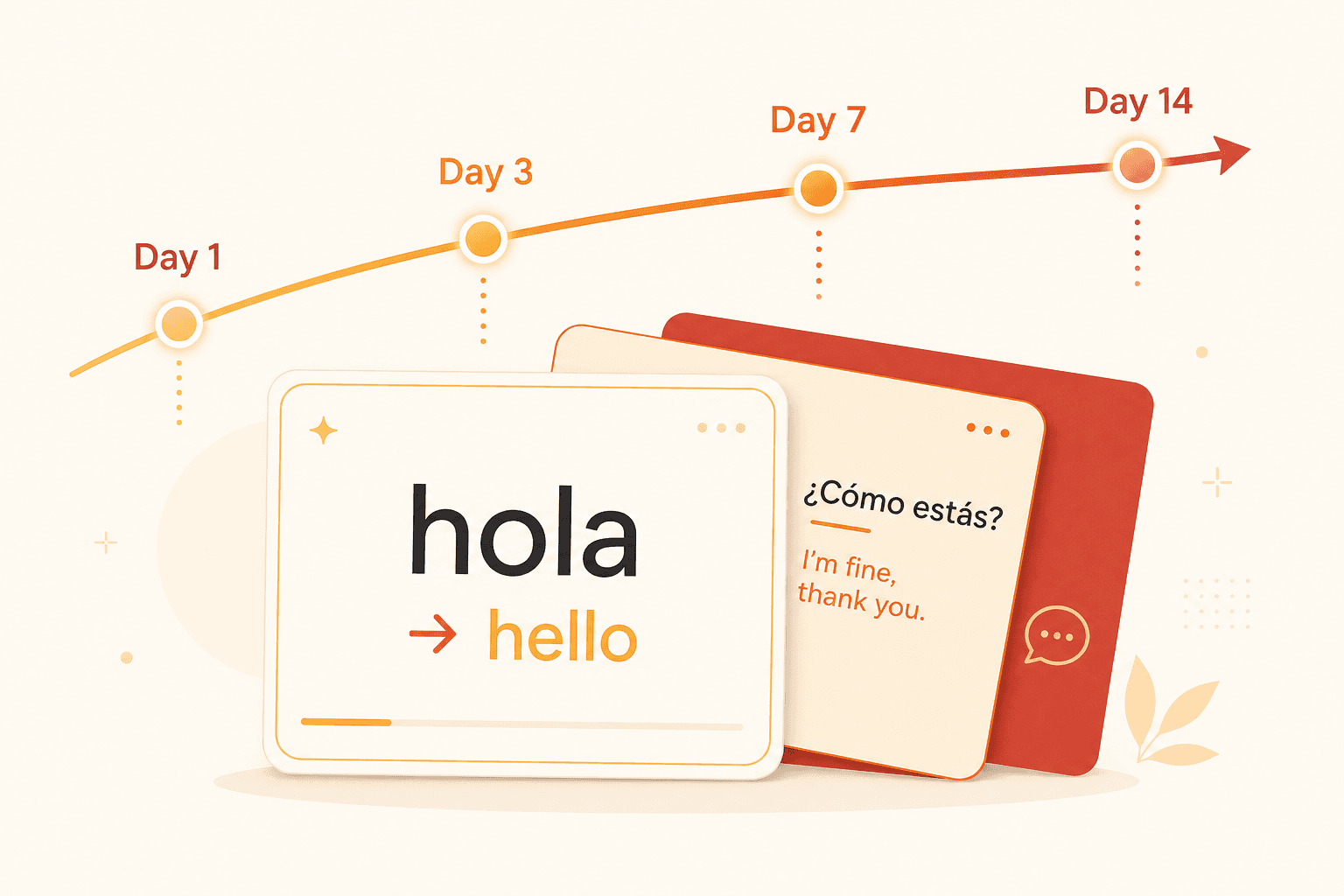
In the 1880s, Hermann Ebbinghaus mapped what happens to new memories without reinforcement. The pattern he found — the forgetting curve — is steep: roughly half of new information is lost within the first hour, about 70% within a day, and close to 90% within a week if nothing triggers a review. For language learners, this means a vocabulary list studied on Sunday is largely gone by Monday morning.
Spaced repetition directly counters this decay. Instead of reviewing everything on a fixed schedule, a spaced repetition system (SRS) times each card's review to arrive just before the memory would fade. Cards you find difficult come back sooner; cards you know well are pushed further out. The result is that your review time is concentrated where your memory needs it most.
Researcher Robert Bjork at UCLA describes this retrieval effort as a "desirable difficulty" — the slight struggle of pulling a word from memory, rather than simply seeing it again, is precisely what makes the memory stronger. This is why active recall (seeing a prompt and generating the answer before flipping the card) is so much more effective than passive review.
The research on spacing intervals is also specific. Work by Cepeda and colleagues found that the optimal gap between study sessions is roughly 10–20% of the intended retention period — so if you want to remember something for a month, sessions spaced about three to five days apart produce the best results. Spaced repetition apps handle this calculation automatically, which is one of the main reasons they outperform manual review schedules.
Active recall is the process of testing yourself, rather than just passively rereading notes… Spaced repetition takes this a step further by resurfacing the card just before you would have forgotten it.
The effect sizes in controlled studies are substantial. A 2024–2025 study published in Frontiers in Medicine (n=90 students) found that learners using digital flashcards with spaced repetition intervals of 1, 3, 7, 14, and 28 days scored 16.24 on post-tests compared to 11.89 for students using traditional study methods — a statistically significant difference (p<0.0001). Over 90% of the spaced repetition group reported improved retention and confidence. The study was conducted in a medical education context, but the underlying mechanism — spaced retrieval practice — is the same one that powers Spanish vocabulary acquisition.
What to Study First: Frequency Over Theme
Most beginner Spanish courses organize vocabulary by theme: food, family, travel, the office. It feels logical — learn words you'll use in a restaurant before your trip. But thematic organization is inefficient for building conversational ability, because high-frequency words are scattered across themes rather than concentrated in any one topic.
The more effective approach is frequency-first: prioritize the words that appear most often in real Spanish conversation. The top 1,000–2,000 most common Spanish words cover approximately 80–90% of everyday spoken language. Mastering these words gives you the scaffolding to understand and participate in conversations across any topic, because the same core vocabulary appears everywhere — in restaurants, on the phone, in news, in casual speech.
This is the principle behind what Migaku describes as the golden rule for quality Spanish decks: teach vocabulary in frequency order with level-appropriate sentence context. The target word should be the only unknown in the example sentence — everything else should already be familiar. This keeps each card genuinely learnable rather than overwhelming.
Beginner Vocabulary Anchors to Cover First
For A0–A1 learners, certain vocabulary clusters act as structural anchors — they appear in almost every conversation and unlock the ability to form basic sentences. Prioritize these before expanding into other vocabulary:
- Greetings and basic social phrases — hola, buenos días, ¿cómo estás?, gracias, de nada, por favor. These are the entry points to every interaction.
- Numbers 1–100 — used constantly for prices, times, dates, ages, and quantities. Don't skip these.
- The 20–30 most common verbs — ser, estar, tener, hacer, ir, querer, poder, saber, venir, decir. These verbs appear in virtually every sentence.
- The ser vs. estar distinction — both translate to "to be" in English, but they are used in completely different contexts. Ser describes permanent or inherent characteristics; estar describes states, conditions, and locations. Confusing them is one of the most common beginner errors, and flashcards with sentence-context examples are the most efficient way to internalize the difference early.
- High-frequency phrases over isolated words — "no entiendo" (I don't understand), "¿puedes repetir?" (can you repeat?), "¿cuánto cuesta?" (how much does it cost?). Phrases give you functional language immediately, even before you fully understand their grammar.
How to Design a Spanish Flashcard That Actually Works
Card design is where most beginners make their most consequential mistakes — and where the biggest gains are available. A well-designed card trains the mental skill you actually need; a poorly designed one trains a weaker, less useful version of it.
Card Direction: English → Spanish, Not the Other Way Around
The single most important card design decision is which side you see first. Most beginners default to seeing the Spanish word and recalling the English meaning — but this trains recognition, not production. You learn to understand Spanish, not to speak it.
As LearnCraft Spanish explains, if you're a native English speaker, your thoughts are currently occurring in English. The fastest path to speaking Spanish is to train your brain to redirect those English thoughts into Spanish — which means your cards should show the English prompt and require you to produce the Spanish answer. Seeing "to want" and retrieving "querer" is the mental action that mirrors real conversation.
One Concept Per Card
Each card should test exactly one thing. A card showing "to be" on the front and "ser / estar" on the back teaches nothing — it just confirms you know two words exist. Instead, make separate cards: one for ser with a sentence context showing permanent characteristics, one for estar with a sentence context showing a temporary state. The one-concept rule keeps every card's review meaningful and prevents you from gaming your own memory.
Sentence Context Over Single Words
Single-word cards are the most common beginner mistake in card design. A card showing "for" on the front and "por" on the back is actively misleading — Spanish has two translations for "for" (por and para) with distinct grammatical uses that single-word cards cannot convey. You'll memorize the association and then produce the wrong word in conversation.
Sentence-context cards solve this. Instead of "for → por," a better card front might be: "I'm doing this for you" with the back showing "Lo hago por ti." The sentence anchors the word to its correct grammatical and semantic context. At the A0–A1 level, keep the sentence simple — the target word should be the only element you don't already know.
Include Audio When Your App Supports It
Spanish pronunciation is phonetically consistent, but beginners who skip audio build silent mental representations of words — they know the spelling but not the sound. When they encounter the word in conversation, there's a processing gap. Apps like Brainscape include native-speaker audio on cards; Anki supports audio files in decks; Mora uses text-to-speech with native pronunciation. Enable audio from the start, even if it feels slower. You're building the sound-to-meaning connection alongside the text-to-meaning connection.
Choosing Your App: Anki, Quizlet, and Brainscape Compared
The right app depends primarily on one question: how much setup are you willing to do before you start studying? All three tools work. They differ in how much you configure versus how much comes ready to use.
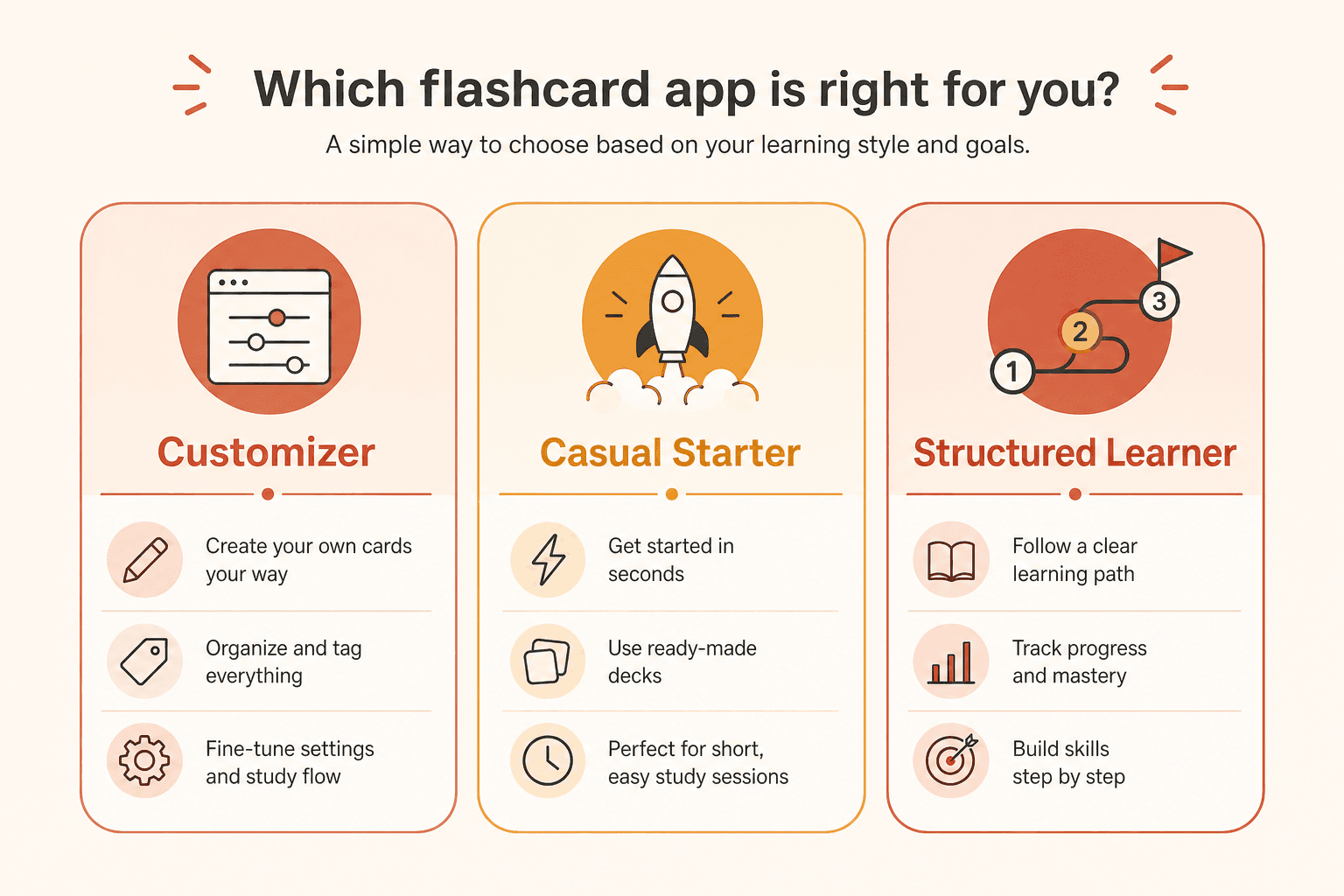
| App | SRS Algorithm | Setup Required | Free Tier | Best For |
|---|---|---|---|---|
| Anki | FSRS (as of v23.10) — the most sophisticated open-source SRS algorithm available | High — you build or import a deck before studying anything | Free on desktop and Android; iOS app is $24.99 one-time (pricing last checked June 2026) | Learners willing to configure a deck or import a shared deck; strong for long-term serious study |
| Quizlet | Limited — basic study modes, not true interval-based SRS scheduling | Very low — create a set or find an existing one and start immediately | Meaningful free tier; paid plans unlock additional study modes | Casual beginners who want to start studying within minutes; classroom learners |
| Brainscape | Proprietary confidence-based SRS — learners self-rate confidence after each card | None for the curriculum — pre-built A0→conversational path ready to use | Free to start; ~$8/month for full access (pricing last checked June 2026) | Learners who want a structured, pre-sequenced curriculum with built-in audio |
Anki: Powerful, But You Have to Build It
Anki is open-source and runs the FSRS (Free Spaced Repetition Scheduler) algorithm, which is one of the most sophisticated SRS implementations available. It adapts to your individual memory patterns across each card, not just difficulty ratings. The desktop and Android apps are free; the iOS app is a one-time purchase of $24.99 — this is how the developers fund the project.
The tradeoff is setup. Anki ships with no Spanish content — you either build your own deck or import a shared deck from the AnkiWeb community library. For beginners who are willing to spend 30–60 minutes on initial configuration, Anki offers the most powerful and customizable long-term study system. For beginners who want to start studying today, the setup cost is a real barrier.
Quizlet: Frictionless, But Limited Scheduling
Quizlet's strength is immediate usability. You can find an existing Spanish vocabulary set or create your own in minutes, and the interface is intuitive enough for complete beginners. It works well for classroom contexts and for learners who want to study casually without configuring anything.
The limitation is that Quizlet does not offer true interval-based SRS scheduling in the way Anki or Brainscape do. Review modes exist, but the scheduling logic is less sophisticated — it won't time your reviews to land at the optimal moment before forgetting. For casual beginners this is acceptable; for learners who want the full benefit of spaced repetition, it's a meaningful constraint.
Brainscape: Pre-Built Curriculum with Built-In Audio
Brainscape's Spanish curriculum is designed specifically for the A0-to-conversational progression. The platform offers 9,000+ vocabulary cards ordered from most fundamental to most advanced — starting with common greetings, basic nouns, numbers, and essential conversation — plus over 10,000 audio cards with native-speaker pronunciation. The sequencing is handled by Brainscape's linguists, so you don't need to make vocabulary selection decisions yourself.
The SRS mechanism uses confidence-based repetition: after each card, you rate how well you knew it (1–5), and the system schedules the next review accordingly. It's free to start, with full access at approximately $8/month. For beginners who want a structured path without configuration overhead, Brainscape is the most immediately useful option.
Mora: A Newer Alternative Worth Noting
Mora is a newer SRS app with a cleaner interface than Anki, text-to-speech pronunciation, recall and typing modes, and CSV import for custom decks. It's worth considering for self-directed learners who want Anki-style flexibility without Anki's dated interface. The ecosystem is smaller and third-party coverage is limited, so treat it as a secondary option rather than a primary recommendation at this stage.
Building a Daily Study Habit That Sticks
Spaced repetition only works if you show up when the algorithm schedules your reviews. A missed day doesn't just mean you didn't study — it means cards that were due for review are now past their optimal interval, and the forgetting curve has already started pulling them down. Consistency is the mechanism, not a motivational bonus.
The research is clear on session length: shorter, more frequent sessions outperform longer, infrequent ones. As the science of spaced repetition shows, studying a word ten times across ten days produces far better long-term retention than studying it one hundred times in a single session. For beginners, 15–20 minutes of daily review is more valuable than a two-hour Saturday session.
Practical Habits That Support Daily Review
- Habit stack your review session — attach it to something you already do daily, like morning coffee, a commute, or the first ten minutes of lunch. The habit doesn't need a new time slot; it needs an existing anchor.
- Shuffle your deck — reviewing cards in the same order every time lets you anticipate the next card rather than genuinely retrieve it. Shuffling forces real retrieval and, as research confirms, leads to better long-term retention by simulating the unpredictability of actual conversation.
- Speak your answers aloud — don't just think the Spanish answer before flipping the card. Say it. This builds the motor memory and pronunciation patterns you'll need when speaking in real time.
- Target ~85% accuracy before adding new cards — if you're getting more than 85% of reviews correct, your intervals are well-calibrated and you have capacity to add new vocabulary. If you're below 85%, slow down on new cards and let the existing ones consolidate. Accuracy well above 95% suggests your intervals may be too conservative.
- Keep new card introductions modest — adding 10–15 new cards per day is sustainable for most beginners. Adding 50 new cards in one session creates a review backlog that compounds over days and becomes discouraging quickly.
Common Beginner Mistakes That Slow Your Progress
Most beginner Spanish flashcard problems are predictable. These are the five mistakes that most consistently undermine progress — and why each one matters.
- Studying Spanish → English only. This trains recognition — you learn to understand Spanish when you hear or read it, but not to produce it when speaking. If your goal includes speaking (and it should), you need English → Spanish cards as the primary direction. Recognition and production are different cognitive skills; recognition alone won't get you to conversation.
- Cramming instead of spacing. Reviewing 200 cards in one sitting feels productive but produces shallow, short-lived memory traces. The forgetting curve works against you — the memories formed in a cram session decay at the same rate as any other new memory, and without spaced follow-up reviews, most of them are gone within a week. Daily 15–20 minute sessions using an SRS app are not a discipline preference; they are the mechanism.
- Memorizing isolated words without sentence context. Single-word cards fail for words with multiple translations (por/para, ser/estar, saber/conocer) and for words whose meaning shifts with context. You'll memorize the association correctly and still use the word wrong in conversation. Sentence-context cards are not harder to make — they just require one extra step — and they produce dramatically more usable knowledge.
- Ignoring pronunciation and skipping audio. Building a vocabulary entirely through text creates a silent mental model of Spanish. When you encounter these words in spoken conversation, there's a processing delay while your brain connects the sound to the text representation. Including audio from the start — even text-to-speech — builds the sound-to-meaning connection in parallel with the text-to-meaning connection.
- Skipping review sessions when cards feel "too easy." The ease of a review session is not a signal that you don't need it — it's a signal that the SRS is working correctly. Cards feel easy because they've been reviewed at the right intervals. Skip those reviews, and the intervals reset. The words that feel most automatic are also the ones most vulnerable to decay if you stop reinforcing them.
Quick-Start Checklist: Your First Week with Spanish Flashcards
The decisions and setup steps below cover everything you need to get a working Spanish flashcard system running in under an hour. Complete these once, then focus on daily review.
- Choose your app based on setup tolerance. If you want to start immediately with a structured curriculum and audio, use Brainscape (free to start). If you're willing to spend time on setup for a more powerful long-term system, use Anki (free on desktop/Android, $24.99 on iOS). If you want the lowest possible friction for casual study, use Quizlet.
- Select a frequency-based deck or use the app's built-in curriculum. Do not build a thematic vocabulary list from scratch. Use a deck ordered by word frequency, or use Brainscape's pre-sequenced curriculum which starts at the most fundamental vocabulary.
- Set card direction to English → Spanish. In Anki, this means the front of your card shows the English prompt and the back shows the Spanish answer. In Brainscape, the default direction already follows this convention. In Quizlet, check your study mode settings.
- Enable audio if your app or deck supports it. Brainscape includes native-speaker audio by default. Mora uses text-to-speech. Anki requires audio files in the deck — look for shared decks that include audio when importing.
- Schedule a 15–20 minute daily review session and attach it to an existing habit. Morning coffee, a commute, or the first break of the day are reliable anchors. Set a recurring reminder for the first week until the habit is established.
- Start with 10–15 new cards per day. This is a sustainable pace that won't create an unmanageable review backlog. Increase the limit only when your accuracy is consistently above 85%.
- Say every Spanish answer aloud before flipping the card. This is the single highest-return habit addition that costs no extra time.
- Rate your cards honestly. Don't mark a card correct because you almost remembered it. The SRS algorithm depends on accurate self-assessment to schedule reviews at the right intervals. Inflating your ratings just means you'll forget the card before it comes back.
Related Resources
- GRE Vocabulary Flashcards: How to Choose the Right Tool and Use It Effectively →
A practical guide for GRE test-takers who feel overwhelmed by flashcard options — covering how the post-2023 GRE actually tests vocabulary, how to evaluate and choose between Anki, Magoosh, Brainscape, Quizlet, and paper cards, and how to build a daily study routine that turns flashcard drilling into real Verbal score gains.
- MCAT Anki Decks: Best Pre-Made Decks, Where to Get Them, and How to Study →
A complete guide for pre-med students on choosing the right MCAT Anki deck for their timeline and section weaknesses — covering every major pre-made deck with honest pros, cons, and download sources, plus a proven study system built around the suspend-first workflow and AAMC integration.
Comments
Join the discussion with an anonymous comment.