
How to Make Effective Flashcards: Writing Rules, Review Systems, and Common Mistakes to Avoid
Most students make flashcards but don't see results because they skip two essential steps: writing cards that force genuine retrieval and reviewing with a system built on active recall and spaced practice. This guide covers the science-backed rules for both — with annotated card examples, format comparisons, and review methods that actually build lasting memory.
Deck Sources
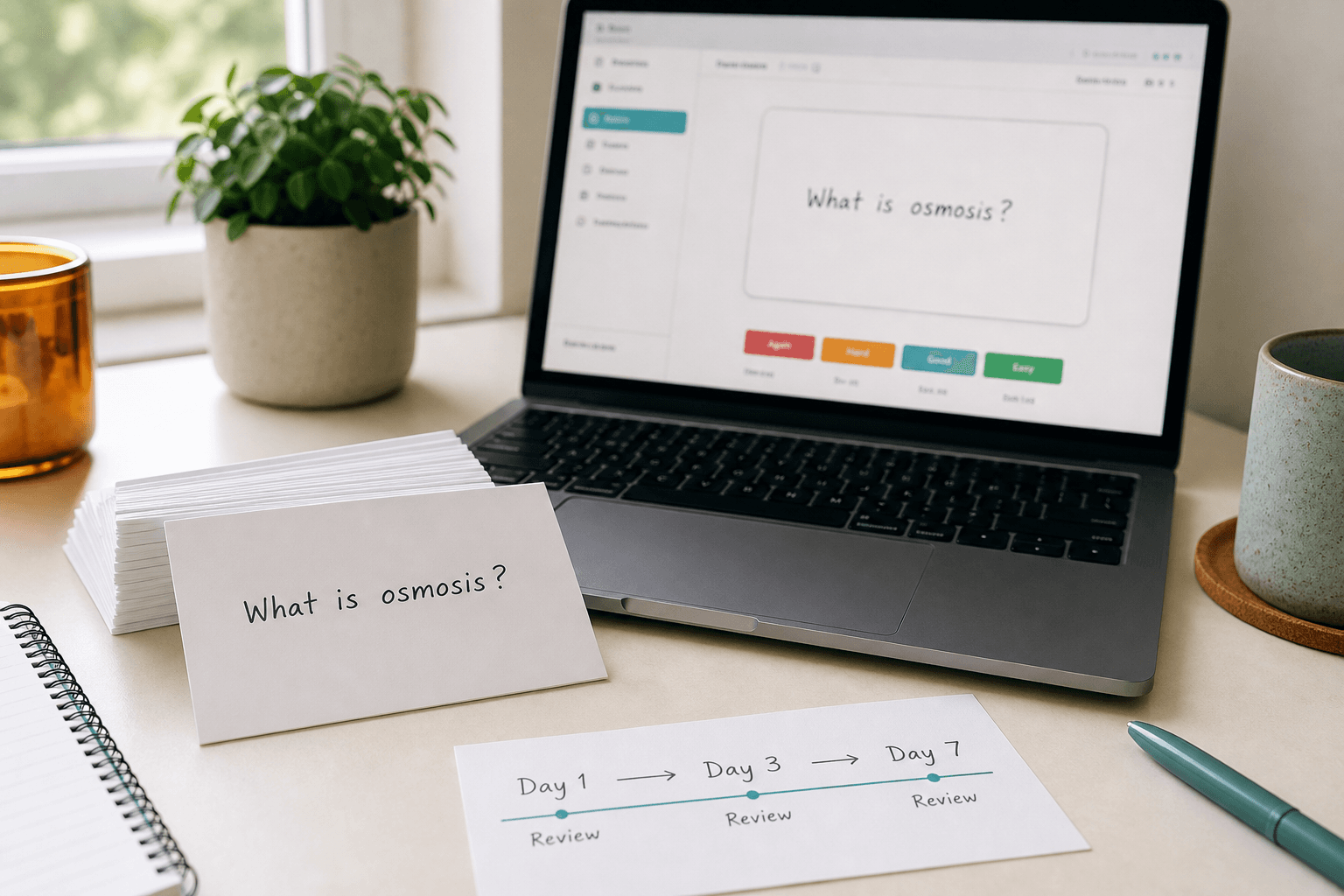
Why Most Flashcards Don't Work
Most students who struggle with flashcards aren't making a single big mistake — they're making two smaller ones at the same time. The first is in how they write their cards. The second is in how they review them. Either problem alone limits results. Together, they create what researchers call the illusion of competence: the feeling of knowing material that you don't actually know.
Here's how it plays out. A student makes a deck of 40 cards before an exam. They flip through them the night before, reading the front, flipping to the back, and thinking "I knew that" — over and over. The next morning, they can't recall half the answers without the card in front of them. The problem isn't the flashcards. It's that flipping a card and recognizing an answer is not the same as retrieving it from memory. Recognition is easy. Retrieval is what exams actually test.
The second layer of the problem is card design. Cards that cram three facts onto one side, copy definitions word-for-word from a textbook, or ask vague questions like "Tell me about the cell" don't give your memory a precise target to retrieve. Spaced repetition software can't fix a badly written card — it will just schedule a useless card more efficiently.
This guide covers both layers: how to write cards that force genuine retrieval, and how to review them with a system that actually builds lasting memory.
The Science Behind Why Flashcards Work (When Done Right)
Three cognitive mechanisms explain why well-made flashcards outperform most other study methods.
The first is the testing effect. Roediger and Karpicke's 2006 research demonstrated that active recall — actually retrieving information from memory — produces roughly 50% more retention after one week than re-reading the same material. Every time you successfully pull an answer out of memory, you strengthen that memory trace. Re-reading only gives you the illusion of familiarity.
The second is the generation effect. When you write your own flashcards — summarizing, filtering, and rephrasing content in your own words — you engage in elaborative rehearsal, which encodes the material more deeply than passive reading. Pre-made decks are useful, but they lose this benefit unless you personalize them with your own examples, mnemonics, or reworded prompts.
The third is the forgetting curve. Without review, you tend to forget roughly 50% of new information within an hour, 70% within 24 hours, and up to 90% within a week. Spaced repetition — reviewing a card just before you're about to forget it — reverses this curve by progressively extending the interval between reviews each time you recall correctly.
Core Card-Writing Rules (With Good and Bad Examples)
The rules below address the most common design failures. Each one is grounded in how memory actually works, not in study folklore.
Rule 1: One Concept Per Card
Working memory holds only about 3–4 pieces of information at once. A card that asks you to recall a definition, two examples, and an exception simultaneously overloads that limit and makes spaced repetition scheduling unreliable — if you get part of it right and part wrong, the algorithm doesn't know what to do with it.
If the answer requires more than two or three sentences, split the card. This is the single most impactful rule: each card should test exactly one fact, definition, step, or relationship.
Rule 2: Write in Your Own Words
Copying a textbook definition onto a card skips the elaborative rehearsal that makes self-written cards effective. Rephrasing forces you to understand the concept, not just transcribe it. A textbook might say "Photosynthesis is the process by which green plants use sunlight to synthesize food." A better card prompt is "How do plants make food from sunlight?" — simpler, more memorable, and harder to answer by rote pattern-matching.
Rule 3: Write Precise, Unambiguous Questions
Vague questions produce vague retrievals. Andy Matuschak's framework for effective retrieval prompts identifies five properties a good card should have: focused (tests one detail), precise (no ambiguity about what's being asked), consistent (produces the same answer every time), tractable (answerable almost all the time), and effortful (requires genuine retrieval, not inference). A card that fails any of these properties is worth rewriting.
A practical test: someone unfamiliar with your subject should be able to read your question and know exactly what kind of answer you're looking for. If they can't, the question is too vague.
Rule 4: Include Enough Context to Make the Card Self-Contained
A card reviewed weeks after you made it needs to stand on its own. If the question only makes sense in the context of the lecture slide it came from, you'll be confused when you see it later. Add just enough framing — the system, the time period, the subject area — to make the question answerable without external reference.
| Bad Card (Front) | Problem | Better Card (Front) |
|---|---|---|
| What are the effects? | Effects of what? No context, no target. | What are the three main effects of cortisol on the immune system? |
| Mitosis vs. meiosis — explain. | Two concepts, open-ended scope, not a retrieval prompt. | What is the key difference between mitosis and meiosis in terms of the number of daughter cells produced? |
| Photosynthesis is the process by which green plants use sunlight to synthesize food from carbon dioxide and water. | This is a statement, not a question. No retrieval required. | What two raw materials do plants use to produce glucose during photosynthesis? |
| What is the French Revolution? | Too broad to retrieve anything specific. | What event in 1789 marked the beginning of the French Revolution? |
| List everything about the krebs cycle. | Overloaded. Multiple facts, no single retrieval target. | What molecule enters the Krebs cycle at the start of each turn? |
Card Formats Compared: When to Use Each Type
Not every fact needs the same card format. Choosing the right format for the type of knowledge you're learning reduces wasted effort and improves retention.
| Format | How It Works | Best For | Watch Out For |
|---|---|---|---|
| Basic Q&A | Question on front, answer on back. | Definitions, facts, direct recall of single items. | Vague or overloaded questions — apply the writing rules above. |
| Cloze deletion | A sentence with one word or phrase blanked out: 'The powerhouse of the cell is the ___.' | Lists, sequences, fill-in-the-blank recall, fast card creation. | Pattern-matching if the sentence structure is too predictable. Never blank multiple items simultaneously — it creates ambiguity about which blank to focus on. |
| Reverse / bidirectional | Same pair tested in both directions: term → definition and definition → term. | Vocabulary, foreign language, any fact where flexible recall matters. | Not every concept needs both directions — use judgment. |
| Image-based / image occlusion | A diagram or image with labels hidden; recall the hidden label. | Anatomy, chemistry diagrams, geography maps, any visual-spatial content. | Requires more setup time; less useful for abstract concepts. |
| Multiple choice | Choose the correct answer from options. | Not recommended — relies on recognition, not recall. Avoid for serious studying. |
For subjects that require deep understanding — STEM courses, social sciences, history — consider mixing in conceptual cards alongside definition cards. Research by McDaniel and colleagues found that cards asking students to compare, contrast, or explain cause-and-effect relationships produced better learning outcomes than cards testing isolated definitions alone. A practical approach: after making a definition card for a term, make a second card that asks how that term relates to something else you've already learned.
How to Review Effectively: Active Recall, Shuffling, and Spaced Practice
Writing good cards is half the work. The other half is reviewing them in a way that forces genuine memory retrieval rather than passive recognition. Most students skip this layer entirely.
Active Recall Before Flipping
Before you flip a card, write or say the answer aloud. This seems obvious, but most students flip immediately when they're unsure — which converts a recall task into a recognition task. Research by Dr. Pooja Agarwal at RetrievalPractice.org found that overt retrieval — producing an answer out loud or in writing before checking — led to greater learning two days later than covert retrieval (just thinking about the answer mentally). The effort of production is part of what makes the memory trace stronger.
The 3-Correct-Answers Rule
Don't remove a card from your active deck after getting it right once. Keep it until you've retrieved it correctly three separate times. Students consistently drop cards too early — experiments in Jeff Karpicke's lab showed that when students decided on their own when to stop reviewing a card, there was no measurable benefit on exam performance. The three-retrieval rule also adds natural spacing lag between reviews, which reinforces the forgetting curve benefit.
Shuffle Every Session and Interleave Topics
Studying cards in the same fixed order every session teaches you the sequence, not the content. Shuffle your deck before each review. Better still, mix cards from different topics or subjects in a single session — this is called interleaving. A study published in Instructional Science found that students who shuffled practice problems across topics significantly outperformed those who studied one topic at a time on delayed recall tests. The effect is strongest when the interleaved topics are related but distinct — which describes most flashcard decks.
The Leitner System for Physical Cards
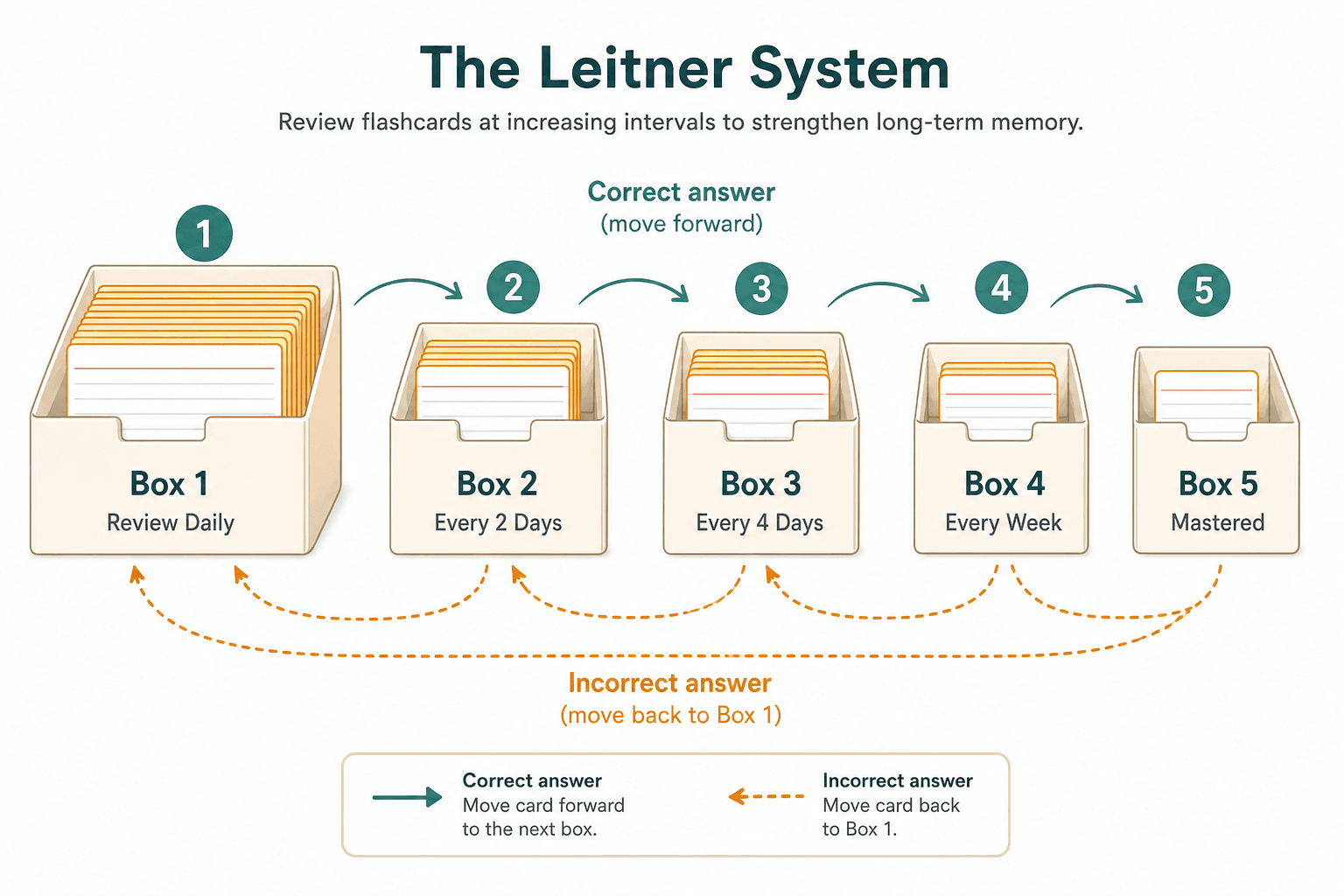
If you use physical index cards, the Leitner system gives you a simple spaced repetition schedule without any software. Introduced by Sebastian Leitner in 1972, it works as follows:
- Set up 3–5 boxes with increasing review intervals — for example: Box 1 (review daily), Box 2 (every 3 days), Box 3 (weekly), Box 4 (every two weeks), Box 5 (mastered).
- All new cards start in Box 1.
- When you answer a card correctly, move it to the next box (longer interval).
- When you answer incorrectly, move it back to Box 1 regardless of which box it was in.
- Only review cards when their box interval comes due — don't review Box 3 cards on a Box 1 day.
Digital SRS Algorithms
Apps like Anki implement the same principle algorithmically. After each review, you rate how well you recalled the answer (typically on a scale from "Again" to "Easy"), and the algorithm adjusts the next review interval accordingly — a correct "Easy" rating extends the interval significantly; "Again" resets it to minutes. The SM-2 algorithm has been the standard for decades; the newer FSRS algorithm adapts more precisely to individual memory patterns. Both are far more efficient than any manual scheduling system for large decks.
The 5 Most Common Flashcard Mistakes (and How to Fix Them)
These are the errors that waste the most study time. Each has a straightforward fix.
- Overloading cards with too much information. A card with five bullet points on the back isn't a flashcard — it's a note. Fix: if the answer is longer than two or three sentences, split the card into multiple focused cards.
- Flipping without attempting retrieval first. Flipping immediately when you're unsure turns every review into a recognition exercise. Fix: cover the back, write or say your best attempt at the answer, then check.
- Never shuffling. Studying cards in the same order every session trains sequential memory, not content memory. Fix: shuffle before every session, and mix cards from different topics when possible.
- Dropping cards after one correct retrieval. Getting a card right once doesn't mean it's in long-term memory. Fix: keep the card in rotation until you've retrieved it correctly three separate times.
- Making cards but not reviewing them consistently. Card creation alone delivers only a fraction of the potential retention benefit. Fix: schedule review sessions in advance — even 15 minutes daily is far more effective than a three-hour cram the night before an exam.
Digital Tools That Support These Habits
The principles in this guide work with physical cards, but digital tools make spaced repetition scheduling significantly more practical — especially for large decks. Here are four tools worth knowing about:
- Anki — Open-source and highly customizable, with both the SM-2 and newer FSRS algorithms available. The most widely used tool for high-volume, long-term memorization. Steep initial learning curve.
- Quizlet — Accessible and widely used, with built-in shuffle, spaced practice modes, and a large library of shared decks. Lower friction to start than Anki.
- RemNote — Integrates note-taking and spaced repetition in the same interface, useful if you want to create flashcards directly from your study notes.
- Brainscape — Uses a confidence-based repetition system where you rate how well you knew each answer on a 1–5 scale, which adjusts review frequency accordingly.
For subject-specific applications of these principles, see GRE Vocabulary Flashcards: How to Choose the Right Tool and Use It Effectively for a high-stakes exam context, or Spanish Flashcards for Beginners: What to Study, How to Make Cards, and Which App to Use for a language-learning application of the same methodology.
Effective Flashcard Checklist
Use this checklist before you start a study session and when you're writing new cards. It takes less than a minute to run through.
Card-Writing Checks
- Each card tests exactly one concept, fact, or relationship — not multiple things at once.
- The question is written in your own words, not copied from a textbook or slide.
- The question is precise enough that someone unfamiliar with the topic would know exactly what answer is expected.
- The card includes enough context to be self-contained — it makes sense weeks after you made it.
- For vocabulary or facts that need flexible recall, a reverse card (definition → term) is also in the deck.
- Cloze deletions blank only one element at a time — not multiple blanks in the same sentence.
Review Checks
- Before flipping each card, write or say the answer aloud — don't flip immediately when uncertain.
- Shuffle the deck before every session; mix topics from different subjects when possible.
- Keep a card in active rotation until it has been retrieved correctly three separate times.
- Use spaced intervals — review new and difficult cards more frequently, mastered cards less often.
- Retire or suspend cards you've genuinely mastered to focus review time on weaker material.
- Review consistently across days and weeks — short daily sessions outperform long pre-exam crams.
Related Resources
- MCAT Anki Decks: Best Pre-Made Decks, Where to Get Them, and How to Study →
A complete guide for pre-med students on choosing the right MCAT Anki deck for their timeline and section weaknesses — covering every major pre-made deck with honest pros, cons, and download sources, plus a proven study system built around the suspend-first workflow and AAMC integration.
- Spanish Flashcards for Beginners: What to Study, How to Make Cards, and Which App to Use →
A practical, science-backed guide for absolute beginners (A0–A1) on how to use Spanish flashcards effectively — covering which vocabulary to prioritize first, how to design cards that build real speaking ability, and how to choose between Anki, Quizlet, and Brainscape based on how much setup you're willing to do.
- GRE Vocabulary Flashcards: How to Choose the Right Tool and Use It Effectively →
A practical guide for GRE test-takers who feel overwhelmed by flashcard options — covering how the post-2023 GRE actually tests vocabulary, how to evaluate and choose between Anki, Magoosh, Brainscape, Quizlet, and paper cards, and how to build a daily study routine that turns flashcard drilling into real Verbal score gains.
Comments
Join the discussion with an anonymous comment.