
AI-Generated vs. Handmade Flashcards: What the Research Says and How to Choose
Research shows handmade flashcards have a measurable memory advantage when students actively process and phrase content themselves — but AI-generated cards cut creation time by 50–80% and integrate seamlessly with spaced repetition. This guide helps students decide which method fits their subject, timeline, and learning goals, with a hybrid workflow that captures the best of both.
Deck Sources
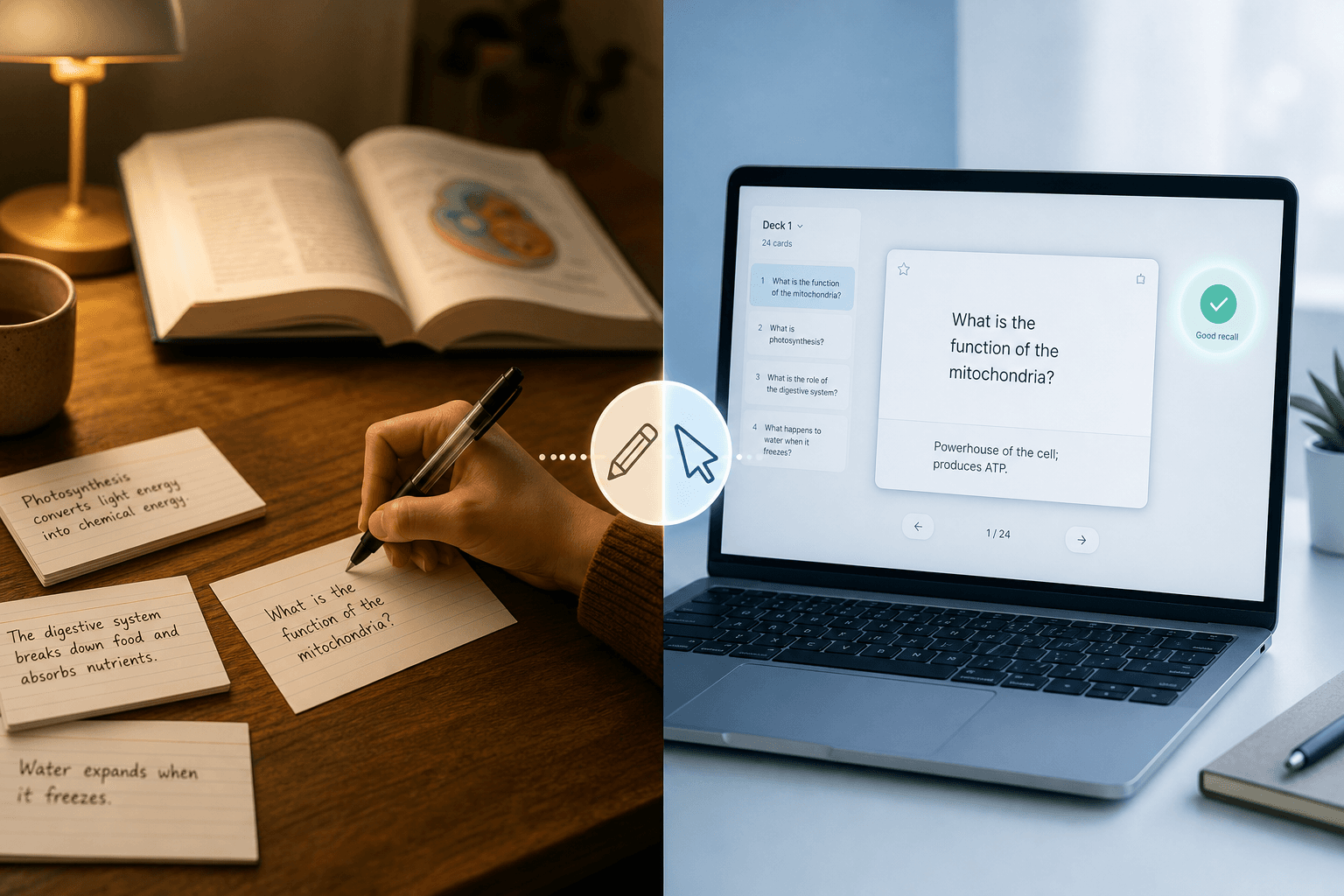
The Real Trade-Off: Time vs. Retention
Every student building a flashcard deck faces the same pressure: you need the cards to actually work, but you also need them ready before the exam. AI tools can generate a full deck in under five minutes. Writing your own cards by hand can take two hours or more for the same material. That gap is real, and it matters.
The problem is that the faster method and the more effective method are not always the same one — and the research shows the gap between them is conditional, not absolute. Neither approach wins universally. The right choice depends on your subject, how much time you have, and how much accuracy the stakes demand.
This guide focuses entirely on the creation method decision: AI vs. handmade vs. hybrid, and when each approach is appropriate. It does not re-cover card-writing quality rules or spaced repetition review mechanics — those are the focus of the companion guide How to Make Effective Flashcards: Writing Rules, Review Systems, and Common Mistakes to Avoid. If you want to know how to structure individual cards once you've decided on a creation method, that article is the right starting point.
What the Research Actually Says About Making Your Own Flashcards
The most directly relevant research comes from Steven Pan and colleagues, published in the Journal of Applied Research in Memory and Cognition. Across six experiments, students who generated their own flashcard definitions and examples consistently outperformed students who studied with premade cards. In five of the six experiments, the advantage was roughly 10 percentage points — approximately a letter grade. In one experiment, self-generating students performed 25% better.
"If a student uses an existing flashcard set, then they are robbing themselves of the learning opportunities that can arise from making their own flashcard sets." — Steven Pan, lead author, as cited in Tech Learning
But this finding comes with two important conditions that are easy to miss.
- The advantage holds only when students paraphrase or generate examples in their own words — not when they copy text verbatim. Copy-and-paste transcription showed no significant memory advantage over using premade cards. Paraphrasing was the most effective generation method, outperforming even example generation.
- The advantage also requires that students be guided on which concepts to study. When students were left to choose their own terms without guidance, premade cards sometimes focused on more useful concepts than what students self-selected. The generation benefit is not automatic — it depends on studying the right material.
A separate line of neuroscience research adds a supporting data point. A study published in Frontiers in Psychology by researchers at the Norwegian University of Science and Technology found that writing by hand produced higher levels of electrical activity across a broader range of interconnected brain regions — covering movement, vision, sensory processing, and memory — compared to typing, where the same simple finger motion produces every letter. This is a supporting observation, not the main argument. The weight of the evidence for handmade cards rests on the active processing decisions involved in generating new phrasing, not on the physical act of writing itself.
What AI Flashcard Tools Actually Offer
The practical case for AI generation is straightforward. Students who adopted AI study tools in 2024–2025 reported cutting preparation time by 50–80% compared to manual methods. What used to take two or more hours of manual card creation can happen in under five minutes. That is not a marginal improvement — it is a different category of time investment.
- Speed: AI processes a full PDF, slide deck, or lecture transcript and produces a structured deck in seconds, removing the creation bottleneck entirely.
- Spaced repetition integration: Most AI flashcard tools export directly into Anki, Quizlet, or their own SRS systems, so the deck is review-ready from day one. A 2026 meta-analysis found spaced repetition produced a long-term retention effect size of d=0.78 — the scaffolding matters, and AI makes it frictionless to use.
- Adaptive prioritization: Some tools track performance and surface weaker cards more frequently, without requiring manual Leitner box management.
- Format flexibility: AI can process any input — textbook PDFs, uploaded notes, recorded lecture transcripts, or plain topic prompts — and produce cards from material you already have.
- Scalability: For high-volume subjects like anatomy, pharmacology, or vocabulary acquisition, generating hundreds of cards manually is not realistic. AI makes large-scale deck building feasible.
Where AI Flashcards Fall Short
The efficiency gains are real, but so are the failure modes. Understanding where AI generation breaks down is essential before committing a deck to a review schedule.
- Inaccuracy risk: A 2025 study in BMC Medical Education found that 31% of AI-generated assessment content was not suitable for direct use. This figure comes from a medical education context — it is not a universal accuracy rate for all AI flashcard tools across all subjects. But it signals a pattern: in specialized, high-stakes domains, AI errors are frequent enough to require systematic review before studying.
- Hallucination with false confidence: AI models tend to use more confident language when generating incorrect information than when generating accurate content, making errors nearly impossible to detect without subject expertise. A wrong definition reads exactly like a correct one.
- Surface-level recall bias: AI defaults to definition-style cards. Application cards, scenario cards, and comparison cards — the types that build higher-order understanding — require explicit prompting or human curation to appear. Left to its defaults, an AI deck tests recognition of terms, not the ability to use them.
- Passive learning risk: Skipping the creation step removes the active processing decisions that generate the memory advantage in Pan et al.'s research. If you generate a deck and review it without engaging with the content during creation, you lose the cognitive benefit that handmade cards provide.
Head-to-Head: AI vs. Handmade Across Six Dimensions
| Dimension | AI-Generated | Handmade |
|---|---|---|
| Creation time | Very fast — seconds to minutes for a full deck from existing material | Slow — 1–4 hours for equivalent coverage; scales poorly with volume |
| Memory retention | Comparable to premade cards at baseline; no generation advantage without active editing | Measurably higher when students paraphrase in their own words (Pan et al., ~10% advantage; up to 25% in one experiment) |
| Accuracy risk | Present in all subjects; higher in specialized domains (31% unsuitable in medical education context); errors are hard to spot | Student controls accuracy; errors come from misunderstanding, which is itself a learning signal |
| Depth of learning | Default output is surface-level definition cards; application and scenario cards require explicit prompting | Student decides card type and framing; naturally produces varied card formats if following good card-writing practices |
| Scalability | Excellent — handles hundreds or thousands of cards without additional time cost | Poor at scale — manual creation of large decks (anatomy, pharmacology, GRE vocab) is not practical for most students |
| Subject suitability | Best for high-volume factual subjects: vocabulary, anatomy, history dates, law statutes, pharmacology definitions | Best for conceptual subjects: philosophy, literary analysis, legal reasoning, advanced math proof understanding |
Decision Framework: Which Method Fits Your Subject?
The most useful way to choose a creation method is by subject type. The cognitive demands of different subjects map onto the strengths and weaknesses of each approach in predictable ways.
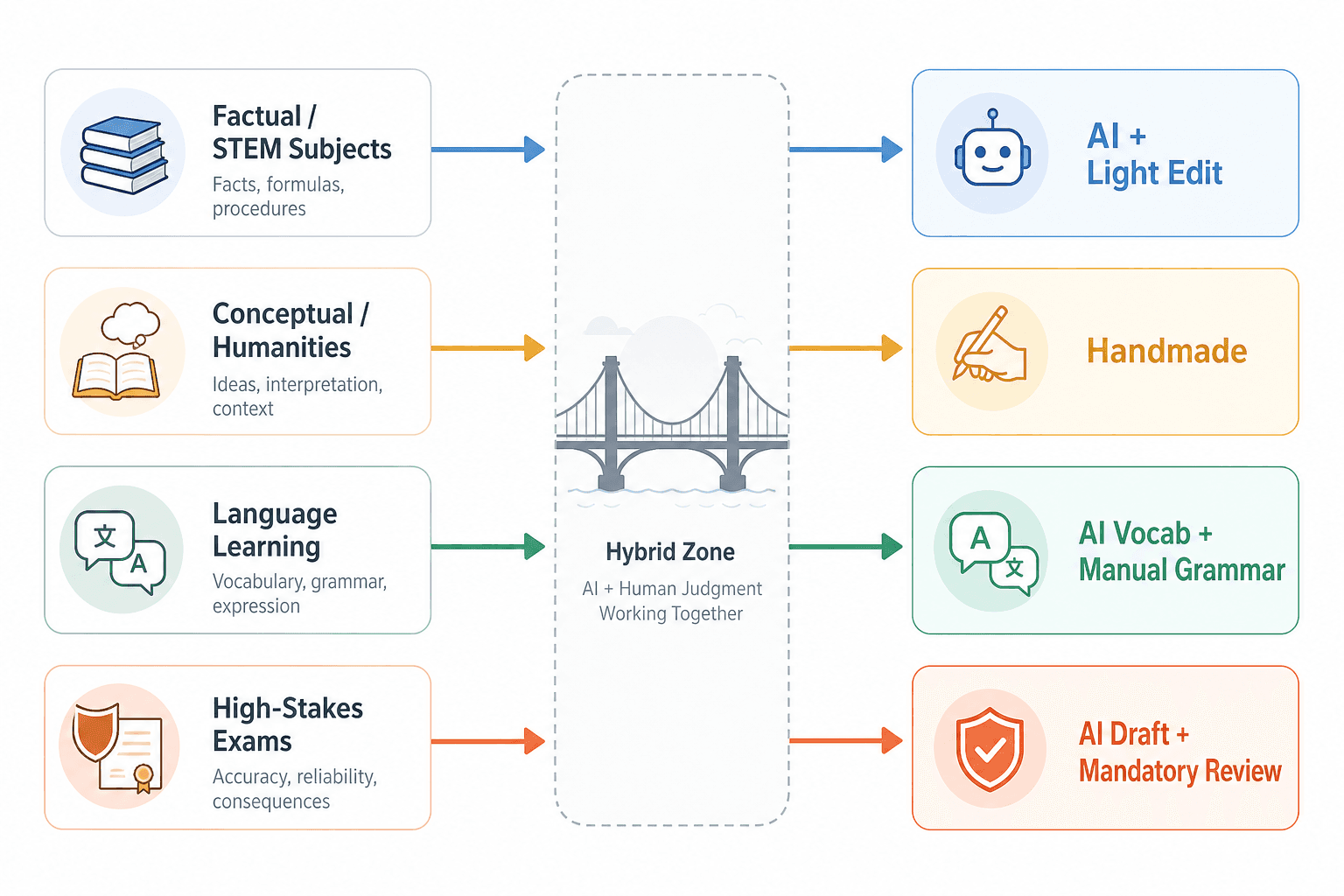
High-Volume Factual Subjects → AI Generation + Light Editing
Anatomy, pharmacology, history dates, vocabulary lists, law statutes, and biochemistry pathways all share the same characteristic: there are hundreds or thousands of discrete facts to memorize, and the facts themselves are not ambiguous. For these subjects, the time cost of manual creation is prohibitive, and the accuracy of individual AI-generated definitions is easier to verify quickly because you can spot a wrong drug mechanism or a wrong date.
AI generation followed by a 5–10 minute accuracy review is the most efficient approach. You get the volume coverage without the creation bottleneck, and the review step catches errors before they enter your long-term memory.
Conceptual Subjects → Handmade Cards in Your Own Words
Philosophy, literary analysis, legal reasoning, and advanced mathematical proof understanding do not translate cleanly into flashcard format. AI tends to oversimplify nuanced arguments into one-line definitions that strip out the reasoning structure. More importantly, these are subjects where the process of deciding how to phrase a concept is the studying. Writing your own explanation of a philosophical argument or a legal doctrine forces you to confront what you actually understand versus what you only recognize.
For these subjects, handmade cards written in your own words consistently outperform AI-generated alternatives. The extra time investment is not inefficiency — it is the learning.
Language Learning → AI for Vocabulary Volume, Manual for Grammar Nuance
Language learning splits naturally by card type. Vocabulary acquisition at scale — building a 2,000-word Spanish deck or a 1,500-word Mandarin character set — is exactly the kind of high-volume factual task where AI generation paired with Anki or Quizlet's spaced repetition is most efficient. The definitions are straightforward to verify, and the volume makes manual creation impractical.
Grammar, on the other hand, benefits from handmade examples you construct yourself. Writing your own example sentences for a new tense or case structure forces active processing that a pre-generated example cannot replicate.
High-Stakes Professional Exams → AI as First Draft Only, Mandatory Human Review
The Hybrid Workflow: How to Get the Best of Both
For most students, the optimal approach is neither pure AI generation nor pure manual creation. A hybrid workflow captures most of the cognitive benefit of handmade cards at a fraction of the time cost.
- Generate from your own source material — not generic prompts. Upload your lecture slides, textbook chapter, or class notes as the AI input. Cards generated from your actual course material are more likely to match your professor's framing and the specific concepts you will be tested on. Generic prompts like "make flashcards about the Civil War" produce generic cards.
- Review the deck for accuracy (5–10 minutes per deck). Read every card before it enters your review rotation. Flag cards with definitions you cannot verify against your source material. Delete or rewrite them before studying — not after you have already reviewed them repeatedly.
- Edit phrasing into your own words for the most important cards. You do not need to rewrite every card. Focus on the 20–30% of cards that cover core concepts, high-stakes distinctions, or material you find genuinely difficult. Rewriting these into your own language is where the cognitive processing benefit from Pan et al.'s research is activated. Follow card-writing best practices during this editing step — one concept per card, question format over definition format where possible.
- Add 5–10 personal cards per study session for concepts AI missed or oversimplified. AI defaults to what is explicitly stated in the source material. It misses the connections between concepts, the exceptions your professor emphasized in class, and the application scenarios that appear on exams. Your manual additions cover this gap.
Tools That Support Each Approach
Tool choice should follow your use case, not the other way around. Pricing for all of these tools changes frequently, so no prices are listed here — check each tool's current pricing page directly.
- Anki + ChatGPT: The standard combination for serious STEM and medical students. Use ChatGPT to generate cards from your own uploaded material, then import into Anki for FSRS or SM-2 spaced repetition. Anki's shared deck library also provides a starting point for well-established subjects (MCAT, Step 1, language vocabulary).
- NotebookLM: Best for minimizing hallucination risk. NotebookLM generates cards grounded entirely in your uploaded documents, which means it cannot produce claims that are not present in your source material. Useful for history, law, and social sciences where source fidelity matters.
- RemNote: Designed for a notes-to-flashcards workflow. As you take notes, RemNote can convert them into cards automatically. Well-suited for lecture-heavy courses where your notes are the primary source material.
- Quizlet AI: Best for quick study sessions and subjects where rapid vocabulary acquisition is the goal. Lower friction than Anki for beginners. Less configurable for advanced spaced repetition needs.
- ChatGPT direct: Useful when you need custom card formats — step-by-step problem solutions for math, case-based scenarios for law, or application questions for STEM subjects that standard AI card tools do not generate by default.
Choosing the Right Mix for Your Situation
The creation method should match three things: the cognitive demands of the subject, the accuracy stakes of being wrong, and the time you actually have. High-volume factual subjects with lower stakes per error favor AI generation with light editing. Conceptual subjects and high-stakes professional exams favor more manual engagement — either handmade cards from scratch or a hybrid workflow with systematic review.
For most students in most subjects, the hybrid workflow is the practical default: generate with AI from your own source material, review for accuracy, edit the most important cards into your own phrasing, and add a small number of personal cards each session for concepts the AI missed. This approach gets you most of the retention benefit of manual creation at a fraction of the time cost.
Related Resources
- GRE Vocabulary Flashcards: How to Choose the Right Tool and Use It Effectively →
A practical guide for GRE test-takers who feel overwhelmed by flashcard options — covering how the post-2023 GRE actually tests vocabulary, how to evaluate and choose between Anki, Magoosh, Brainscape, Quizlet, and paper cards, and how to build a daily study routine that turns flashcard drilling into real Verbal score gains.
- MCAT Anki Decks: Best Pre-Made Decks, Where to Get Them, and How to Study →
A complete guide for pre-med students on choosing the right MCAT Anki deck for their timeline and section weaknesses — covering every major pre-made deck with honest pros, cons, and download sources, plus a proven study system built around the suspend-first workflow and AAMC integration.
- How to Make Effective Flashcards: Writing Rules, Review Systems, and Common Mistakes to Avoid →
Most students make flashcards but don't see results because they skip two essential steps: writing cards that force genuine retrieval and reviewing with a system built on active recall and spaced practice. This guide covers the science-backed rules for both — with annotated card examples, format comparisons, and review methods that actually build lasting memory.
Comments
Join the discussion with an anonymous comment.